



Spreadsheet Ranger
-
Posts
1,979 -
Joined
-
Last visited
-
Days Won
32
Content Type
Profiles
Forums
Events
Articles
Everything posted by Spreadsheet Ranger
-
If this can keep up then I will be happy, however the reality of the past few weeks means this will need to continue for at least 3 weeks to make up for all the loses.
-

Shares & Home Bond Financial Help Questions
Spreadsheet Ranger replied to Shirou's topic in General Finance
I will leave it. (I would sell Nu-World personally, just because I cannot think this latest scandal can be good in the long term). Capitec great company, Discovery great company to own shares in (Not a company I would use myself - Shaftcentral), don't know the other two, but AXL I would keep I honestly do not believe they would go bust again. If they do then yea I don't know couple of us will be upset. Do you have the ETFs in your TFSA or normal portfolio? Either way I won't sell them. -
Mmmmm - Seems the justonelap guys ain't no Sygnia fan https://justonelap.com/podcast-investing-troubled-times/
-
Mmmm, (Wear And Tear Depreciation Allowance - Sars) this is definitely allowed I too am just not clued up how the qualifying criteria works on this. Dammit we need a tax professional on here. Here is some vague info, but seems you need a degree in order to make sense of it - Wear-and-tear or depreciation allowance
-
Ballito, KZN AnitZuma Protest 07 April 2017 Photo's #SaveSA
Spreadsheet Ranger replied to Brendan's topic in General Chat
Of course all links welcome -
As die dag eers so begin. As for lonmin, I am not sure, all in all I am not touching it, too much risk for my appetite.

-
Your opinion considering the current state of affairs
Spreadsheet Ranger replied to Bandit's topic in General Finance
Currently I reshuffled my entire TFSA and it is now in line with the ebook so that I can practise what I preached. So far so good GLPROP starting to pick up. DbxWD will be solid and then NFEMOM is green. Nothing shining in my TFSA, but at least most is green which I think one should probably be thankful for given our current state of affairs. -
Quote button not working for me
Spreadsheet Ranger replied to Purply's topic in Site News & Feedback
You had him quoted previously, but never cleared. When you reply you will see at the bottom of the box insert quoted message or de-select.
-
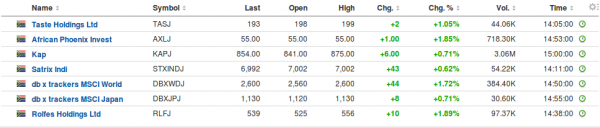
Luckily the Taste Holdings share price did not tank yet. Guess it's now a sit tight and wait for the next announcement.
-
I'm in TAS already so I'll need to ride it out all in all I'm very positive for this company's future. However it won't make money yet I suspect it will be 2 or 3 years still before the share price does anything remarkable. That R1.50 they talk about in the sens. I don't like it all that much especially not if the market slams the price down tomorrow.
-
Okey, so TAS had a sense today. Not impressed with the claw back. I do agree about pumping the food division though, but overall I am not sure. Essentially a reverse rights issue. TASTE sens http://105.30.22.93/SENS_20170404_S383415.pdf
-
Hopefully TAS will pick up tomorrow, it looks like they are on the right path now.
-
Hahahahahahaha I like that! Bank Patties
-
^^^ hahahahaha
-
@Groovy First Rand seems on special! What makes you like them? I always wanted to buy banks, but I don't really understand the pros and cons of buying shares in them particularly apart form capitec who is a odd ball.
-
@Groovy hold onto your seat my brother. Today's gonna be a roller-coaster ride of note.
-
OVERVIEW In our opinion, the executive changes initiated by President Zuma have put at risk fiscal and growth outcomes. We assess that contingent liabilities to the state are rising. We are therefore lowering our long-term foreign currency sovereign credit rating on the Republic of South Africa to 'BB+' from 'BBB-' and the long-term local currency rating to 'BBB-' from 'BBB'. The negative outlook reflects our view that political risks will remain elevated this year, and that policy shifts are likely, which could undermine fiscal and economic growth outcomes more than we currently project. RATING ACTION On April 3, 2017, S&P Global Ratings lowered the long-term foreign currency sovereign credit rating on the Republic of South Africa to 'BB+' from 'BBB-' and the long-term local currency rating to 'BBB-' from 'BBB'. We also lowered the short-term foreign currency rating to 'B' from 'A-3' and the short-term local currency rating to 'A-3' from 'A-2'. The outlook on all the long-term ratings is negative. In addition, we lowered the long-term South Africa national scale rating to 'zaAA-' from 'zaAAA'. We affirmed the short-term national scale rating at 'zaA-1'. As a "sovereign rating" (as defined in EU CRA Regulation 1060/2009 "EU CRA Regulation"), the ratings on the Republic of South Africa are subject to certain publication restrictions set out in Art 8a of the EU CRA Regulation, including publication in accordance with a pre-established calendar (see "Calendar Of 2017 EMEA Sovereign, Regional, And Local Government Rating Publication Dates," published Dec. 16, 2016, on RatingsDirect). Under the EU CRA Regulation, deviations from the announced calendar are allowed only in limited circumstances and must be accompanied by a detailed explanation of the reasons for the deviation. In this case, the reasons for the deviation are the heightened political and institutional uncertainties that have arisen from the recent changes in executive leadership. The next scheduled rating publication on the sovereign rating on the Republic of South Africa will be on June 2, 2017. RATIONALE The downgrade reflects our view that the divisions in the ANC-led government that have led to changes in the executive leadership, including the finance minister, have put policy continuity at risk. This has increased the likelihood that economic growth and fiscal outcomes could suffer. The rating action also reflects our view that contingent liabilities to the state, particularly in the energy sector, are on the rise, and that previous plans to improve the underlying financial position of Eskom may not be implemented in a comprehensive and timely manner. In our view, higher risks of budgetary slippage will also put upward pressure on South Africa's cost of capital, further dampening already-modest growth. Internal government and party divisions could, we believe, delay fiscal and structural reforms, and potentially erode the trust that had been established between business leaders and labour representatives (including in the critical mining sector). An additional risk is that businesses may now choose to withhold investment decisions that would otherwise have supported economic growth. We think that ongoing tensions and the potential for further event risk could weigh on investor confidence and exchange rates, and potentially drive increases in real interest rates. We have also reassessed South Africa's contingent liabilities. This reflects the increased risk that non-financial public enterprises will need further extraordinary government support. We expect guarantee utilizations will reach South African rand (ZAR) 500 billion in 2020, or 10% of 2017 GDP. The utilizations are dominated mainly by Eskom (BB-/Negative/--), which benefits from a government guarantee framework of ZAR350 billion (US$25 billion)--about 7% of 2017 GDP. We estimate Eskom will have used up to ZAR300 billion of this framework by 2020. South Africa's energy regulator has capped Eskom's permitted 2017/2018 tariff increase at 2.2%--with negative implications for its financial performance. Eskom will fund the resulting revenue gap via borrowings of up to ZAR70 billion, of which up to half may utilise government guarantees. Other state-owned entities that we think still pose a risk to the country's fiscal outlook include national road agency Sanral (not rated), which is reported to have revenue collection challenges with its Gauteng tolling system, and South African Airways (not rated), which may be unable to obtain financing without additional government support. While governance reforms have proceeded at the airline, Eskom still has to complete its board appointments and appoint a permanent CEO. Broader reforms to state-owned enterprises are still being discussed and we do not foresee implementation in the near term. South Africa continues to depend on resident and nonresident purchases of rand-denominated local currency debt to finance its fiscal and external deficits. We estimate that the change in general government debt will average 4.2% of GDP over 2017-2020. On a stock basis, general government debt net of liquid assets increased to about 48% of GDP in 2017 from about 30% in 2010, and we expect it will stabilise at just below 50% of GDP in the next three years. Although less than one-tenth of the government's debt stock is denominated in foreign currency, nonresidents hold about 35% of the government's rand-denominated debt, which could make financing costs vulnerable to foreign investor sentiment, exchange rate fluctuations, and rises in developed market interest rates. We project interest expense will remain at about 11% of government revenues this year. South Africa's pace of economic growth remains a ratings weakness. It continues to be negative on a per capita GDP basis. While the government has identified important reforms and supply bottlenecks in South Africa's highly concentrated economy, delivery has been piecemeal in our opinion. The country's longstanding skills shortage and adverse terms of trade also explain poor growth outcomes, as does the corporate sector's current preference to delay private investment, despite high margins and large cash positions. South Africa's gross external financing needs are large, averaging over 100% of current account receipts (CARs) plus usable reserves. However, they are declining because the current account deficit is narrowing. The trade deficit (surplus in 2016) has seen contraction, but given the small recovery in oil prices (oil constitutes about one-fifth of South Africa's imports) we could see the trade balance weakening again. We could also see weaker domestic demand and a notable increase in exports from the mining and manufacturing sectors, along with a slower pace of increase in imports. We believe sustained real exports growth is likely to be slow over 2017-2020 because of persistent supply-side constraints to production. Import growth will be compressed amid currency weakness and the subdued domestic economy. Therefore, we estimate current account deficits will average close to 4% of GDP over 2017-2020. However, South Africa funds part of its current account deficits with portfolio and other investment flows, which could be volatile. This volatility could stem from global changes in risk appetite; foreign investors reappraising prospective returns in the event of growth or policy slippage in South Africa; or rising interest rates in developed markets. We consider South Africa's monetary policy flexibility, and its track record in achieving price stability, to be important credit strengths. South Africa continues to pursue a floating exchange rate regime. The South African Reserve Bank (SARB; the central bank) does not have exchange rate targets and does not defend any particular exchange rate level. We assess the SARB as being operationally independent, with transparent and credible policies. The repurchase rate is the bank's most important monetary policy instrument. Absent large currency depreciations, we expect that inflation will fall back below 6% this year and remain in the target range of 3%-6% over our three-year forecast horizon. OUTLOOK The negative outlook reflects our view that political risks will remain elevated this year, and that policy shifts are likely which could undermine fiscal and growth outcomes more than we currently project. If fiscal and macroeconomic performance deteriorates substantially from our baseline forecasts, we could consider lowering the ratings. We could revise the outlook to stable if we see political risks reduce and economic growth and/or fiscal outcomes strengthen compared to our baseline projections. Source: http://ewn.co.za/2017/04/03/read-the-full-standard-and-poors-statement-south-africa-credit-rating-junk-status
-
I am so damn glad I did not climb in. I was halfway through the ordering process on EE then got a 500 internal server error and took that as a sign.
-
... I'm interested [emoji3]
-
I am so sure we beat moneyweb to it in that live chat, someone dropped the SENS in there seconds after it was released Back on topic, I am very curious to see what they will do with the fees.
-
Socially responsible investing
Spreadsheet Ranger replied to Spreadsheet Ranger's topic in Investments
@SimonPB of all the members here you are probably the most clued up so I need some insight. Can you explain to me how all this works in terms of the JSE allowing the Gupta's Oakbay Resources to be listed knowing all of this going on and the extent of their involvement in the state of this country? Does this not fall under some sort of Social responsibility? I mean we know for a fact the negatives that happened last night, surely this 188% spike in JSE:ORL (Oakbay Resources and Energy Ltd) is not a coincidence? I guess what I am trying to ask is, what tree should I be barking up at? Does the JSE have a responsibility here or is this a matter for some other agency? Including this new Gupta Bank, surely having them list on the JSE is wrong? -
Oakbay resources Gupta company just rocketing
-
Hard questions being asked today. Pravin Gordhan's media briefing is the stuff of legend. https://www.enca.com/south-africa/catch-it-live-pravin-gordhan-addresses-the-media
-
How is the alsi looking?
-
Rating agencies will probably nail us

