



Platinum Wealth
-
Posts
623 -
Joined
-
Last visited
-
Days Won
24
Content Type
Profiles
Forums
Events
Articles
Everything posted by Platinum Wealth
-
Shoprite Holdings [JSE:SHP] is in talks to open its first stores in Kenya by filling retail space left empty by the struggling Nakumatt Holdings chain. “We are currently in talks with some of the property owners but nothing has been signed,” Shoprite director Gerhard Fritz said in an emailed response to questions. Africa’s biggest food retailer is awaiting the outcome of merger talks between Nakumatt and local rival Tusker Mattresses before deciding whether to proceed, he said. Taking over vacated outlets would be the preferred way for the Cape Town-based company to enter East Africa’s largest economy as the retail market there is “too well established” to build new stores, said Fritz, who runs Shoprite’s African operations outside its home market. The move would represent a major step in the expansion of Shoprite as it seeks to strengthen its position outside South Africa, where consumer confidence has been weak because of sluggish economic growth. The grocer had 2 689 stores in 15 countries across the continent at the end of its last fiscal year, according to its annual report. Shoprite faces competition in Kenya from retailers including Game - owned by South African retailer Massmart Holdings, which in turn is controlled by Wal-Mart Stores - Carrefour of France, run by franchise holder Majid Al Futtaim Holding, and Choppies Enterprises of Botswana. Local grocers include Chandarana Foodplus Supermarkets and Naivas Supermarkets. For its part, Nakumatt has shut more than a dozen branches in Kenya, Uganda and Tanzania as East Africa’s biggest retailer struggles to pay suppliers and owes more than 30 billion Kenyan shillings ($289m) to creditors. Chief executive officer Atul Shah, whose family controls the Nairobi-based company, said last month he was in talks with Tusker, which trades under the Tuskys brand. Shoprite also plans to buy two Nakumatt sites in Uganda, Fritz said. The South African company’s shares closed 0.9% higher at R207.49 rand on Friday in Johannesburg, valuing the grocer at R123bn. Source: Fin24
-
Weakening economic conditions, increased debt repayment burden, rising consumer inflation and stricter lending criteria have seen 100% bonds, especially to first-time buyers, become much harder to get, but it has also placed many potential buyers firmly between a rock and a hard place. “Not only do banks require bigger deposits than before, it has also become more difficult to put money aside in today’s economic climate, as growing financial pressure is forcing consumers to tighten belts even further just to make ends meet,” says JP van der Bergh, founder of Propscan. "However, a sizeable deposit has several significant benefits in addition to increasing your chance of bond approval - it also gives you a jumpstart on the financial process, makes your offer more appealing to sellers as it bumps up the chance of bond approval, naturally decreases your monthly bond repayments, and saves you a considerable amount in interest over the long term.” Kay Geldenhuys from ooba, national mortgage originator, illustrates how a deposit can reduce the overall and monthly costs of buying property: “A home buyer who purchases a house for R1 million with no deposit at a 10.25% interest rate will pay approximately R9 816 per month over 20 years. At the end of the home loan term, the total amount repaid will be R2 355 944. “On the other hand, with a R100 000 deposit, the monthly repayments will be approximately R8 835, and the total repayment will be around R2 120 350. Add the deposit to this and the total comes to R2 220 350 - making the total repayments some R135 594 cheaper than buying without a deposit.” She says it also stands to reason that the smaller the risk for the bank, the more negotiable they will be on the interest rate charged. “Right from the beginning of the home-buying process, it is important to ensure that you know what you can afford to buy and how much deposit you will need,” says Van der Bergh. “Once you have established how much you need to save, the next step is to figure out how to do so as quickly as possible, and in order to do so, you must analyse your spending habits. On a spreadsheet, list all your fixed monthly expenses including existing debts you are currently servicing and make a note of all other regular expenses like the daily cappuccino at the café near work. “Next, go through it with a fine-tooth comb to see where you can cut down on monthly expenditure and determine how much you can realistically afford to save, and then shop around for a high-interest savings or money market account in which to save your money.” Sandy Geffen, Executive Director of Lew Geffen Sotheby’s International Realty in South Africa, says saving a substantial amount of money may seem like a daunting task, but don’t be discouraged. “At first glance, the cutbacks you are able to make may seem to be small amounts, but you will be surprised at how quickly they can add up to a sizeable sum, and you could own your first home sooner than you think,” says Geffen. She offers the following creative tips for saving towards your deposit: 1. Stop smoking. This could add at least R1 000 a month to your deposit fund. 2. Instead of buying takeaways every day, rather spend the extra 10 minutes packing lunch in the morning as it will end up saving you more than pennies at the end of the day, and it’s far healthier. 3. Ask for an insurance re-evaluation because while your insurance premiums probably go up every year, the value of a lot of insured items actually goes down as they age. 4. Cut back on credit and try to pay off and close store cards, especially if you find temptation hard to resist. Remember that when you do eventually apply for a loan, the bank will ask for an income and expenditure statement to prove that you will have sufficient surplus income for the home loan instalment once all household and contractual debt expenses have been met. 5. Before you run out to buy a new seasonal wardrobe, spring clean your closet and unearth the older items of good quality that can be reinvented with accessories or by mixing and matching; 6. If you can’t remember what the inside of your gym looks like and can’t motivate yourself to go, cancel that gym contract and find ways to exercise for free. It might help you to start exercising more regularly, especially now that summer is here. 7. Consider scaling down on your car if a large portion of your monthly income is going towards paying off a car loan; 8. Always go grocery shopping with a list and stick to it - and never go on an empty stomach. Also try and stick to food stores and avoid the hypermarkets where you might be tempted to buy other things you don’t need. Geldenhuys cautions that this savings mindset should not be abandoned once the goal has been met. “Many people throw caution to the wind and shop around for a home that costs the maximum amount the bank has approved, however, given current economic conditions, buyers should rather consider buying for a little less,” says Geldenhuys. “The extra cash can be used to pay off the bond more quickly or saved as a rainy-day fund so that they are prepared for the unforeseen expenses which arise when you own property.” “It’s true that our parents had it much easier in that most were able to afford their first home long before the current average age of first-time buyers which has risen to 34, but what hasn’t changed is the investment value of owning a home,” says Van der Bergh. “It is also one of the most exciting and rewarding purchases you will ever make, so even though it may take a little longer, it’s always worth the effort.” Source: Property24
-
 Renting offers tenants the flexibility of living in a home that meets their short-term needs, while owning a property is a far larger commitment that requires more careful consideration. This is according to Adrian Goslett, Regional Director and CEO of RE/MAX of Southern Africa, who says the potential buyers need do their research before taking the first step towards property ownership. He adds that while there is a multitude of things to consider before buying a home, there are five that every first-time buyer should think about before they embark on their homeownership journey. Here they are: 1. Is there room for growth? Ideally, a property should be viewed as a medium- to long-term investment. On average it takes between seven and ten years for buyers to start seeing a return on their investment, so they need to ensure that the property they purchase meets their needs for at least that time frame. “Does the property have the potential to grow with your developing needs? Over the space of five to ten years a lot can happen, so, if possible, it is best to try to find a home that can accommodate the possible changes. It won’t be an exact science as your five-year plan may not pan out as expected, but it is a good idea to consider the possible life changes that could occur and impact your need for an extra room or additional space,” says Goslett. The growth of your family is not the only kind of growth that should be taken into account. Buying property is an investment, so it makes sense to ensure that the property has the potential for growth in value too. According to Goslett, location is the single biggest influence on a home’s appreciation potential, so buy in the best area you can afford. “Also, research area statistics to ensure that you are buying the property at fair market value. Doing these things will ensure that you can be fairly certain that your investment will see capital appreciation over the long term.” 2. Get back to the basics The first home you buy might not have an array of luxury features, but it is important to make sure that all the basics are in good condition. “Most buyers base their decision on emotion, but it is best to have all the facts about the property before you commit. Have the property inspected thoroughly to ensure that there are no hidden defects that could be costly to repair,” advises Goslett. 3. There is a lifespan to everything Certain features may be in a good condition now but could require repair or replacement in the near future. Everything has a lifespan and may require repairs at some stage, so look at the condition of features such as the roof and flooring. How long will it be until these aspects need to be replaced? Researching the expected remaining life on large-ticket items can help you plan for the future. 4. It’s not about perfect, it’s about right Your first home might not be in perfect condition, but it’s important to make sure that it is the right home for you. “When looking for a home, have a list of three columns: must-haves, nice-to-haves, and negotiables. The must-haves will be the features that you can’t live without, while all other items will add to the home, but will not be essential,” says Goslett. “A lock-up garage is a nice-to-have, but not if it means sacrificing an additional room or larger garden, for example. The priority of each of aspect will be determined by your unique tastes and criteria.” 5. Consider all the costs It is not just the bond repayment that needs to be budgeted for and considered. There are other recurring monthly costs involved in owning and maintaining a home. It is vital to choose a property that fits your budget when all costs are taken into consideration. Things to think about include utilities, rates, and taxes, insurance and maintenance costs. These are not costs that are considered by the bank when approving finance, so it is important to calculate these costs with an experienced real estate agent or a financial adviser. “To ensure that the correct decision is made, which will result in a return on investment and, more importantly, your happiness, take the time to weigh up all the options available to you,” says Goslett. Source: Property24
 -
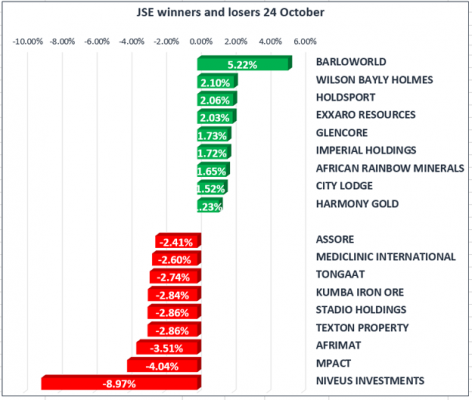
Equities on the JSE closed softer on Tuesday, ahead of the Finance Minister Malusi Gigaba's Medium-term Budget Policy Statement set for Wednesday afternoon. The local bourse failed to gain any significant momentum when it opened, and subsequently traded weaker for the better part of the day. The majority of the blue chip index constituents traded in the red. Among the biggest losers were British American Tobacco [JSE:BTI] and Mediclinic [JSE:MEI] which shed 1.13% and 2.60% respectively. Mining stocks had a mixed day. Harmony Gold [JSE:HAR] and Glencore [JSE:GLN] inched up 1.23% and 1.73%, however AngloGold Ashanti [JSE:ANG] and Lonmin [JSE:LON] shed 1.55% and 1.96%. Banking stocks Standard Bank [JSE:SBK] and Barclays Africa [JSE:BGA] had another day of gains despite a somewhat weaker rand, closing up 0.96% and 0.46% respectively. Diversified miner BHP Billiton [JSE:BIL], meanwhile, inched up 0.44%. But the biggest gainers on Tuesday were WBHO [JSE:WBO] and Barloworld [JSE:BAW] which gained 2.10% and 5.22% respectively. The blue chip JSE Top40 index closed the day down 0.14%, while the JSE All-Share index lost 0.16%. It was a tough day for the local bourse as all the major indices closed in the red. The Industrials index lost 0.12%, while the Resources index lost 0.21%. The Financials index shed 0.15% as the weaker Rand weighed down on it. The rand, meanwhile, reversed overnight gains as the US dollar strengthened. The rand weakened to an intra-day low of R13.78/$ and when the JSE closed it was trading at R13.74/$. Focus now shifts to Gigaba's mini budget speech. As most analysts are expecting tax increases in some form, economists will be keeping a close eye on how the rand reacts. Precious metals Gold was bullish overnight but on Tuesday it lost most of its gains as the US dollar rebounded. Despite having peaked at $1 283.06 per ounce overnight, the precious metal lost ground to trade at $1 273.73/Oz when the JSE closed. Platinum traded softer as it reached an intra-day low of $919.29/Oz, while palladium remained on its bullish trajectory to peak at an intra-day high of $969.00/Oz. When the JSE closed palladium was recorded at $961.04/Oz, while platinum was trading at $920.49/Oz. Brent Crude remained steady on the news that OPEC was working on an exit strategy, as well as discussing the possibility of extending production cuts until the end of next year. Brent Crude was trading at $57.43 per barrel when the JSE closed. After the US markets opened, meanwhile, the Dow Jones Industrials index reached fresh all-time highs. This was mainly driven by better than expected results for Caterpillar [NYSE:CAT], 3M [NYSE:MMM] and McDonalds [NYSE:MCD]. Source: Fin24
-
In difficult economic times, many landlords rely on the rental income their tenants bring in - but what happens if that tenant suddenly decides to move out? “With an absconding tenant, it can be quite difficult as you have to issue a cancellation letter, terminating the lease and indicate the final date of the lease,” says Natalie Muller, Head of Rentals at Jawitz Properties in the Western Cape and Gauteng. “If the tenant’s furniture remains in the property, you have to make arrangements to store the furniture, but this can be at the cost of tenant. You do have to advise the tenant that the furniture needs to be removed or it will be sold to defer costs - you are not allowed to sell the items without a court order,” says Muller. An absconding tenant is still liable for performing in accordance with the clauses of the lease and needs to note that even though they have left the property, they need to formally cancel the lease as per the provisions in The Consumer Protection Act. The Act is defined as allowing the tenant the right to terminate their lease agreement with 20 business days’ notice for whatever, as well as, no reason at all. “This right, however, is subject to penalties and most leases make provision for a penalty that the tenant can be held liable for rental of two to four months depending on the time it takes to find a replacement,” says Muller. The landlord will have the right to claim the costs involved in finding a replacement tenant, as well as the costs to return the property back to the original state it was when the tenant first moved in. Landlords need to know that unless the lease with the tenant has been cancelled, an inspection carried out and the absconding tenant notified of the penalties and charges, they cannot allow a new occupant to move in. It is also important to note that any viewings done at the property without the absconding tenant being present, need to be done having given the absconding tenant a notice of the intended viewing. “Even though the tenant has left they still have the right to the lease, pending the formal cancellation,” says Muller. Landlords should consider themselves lucky if the tenant has left occupancy of the property without owing money. If the right processes are followed, the landlord should be able to rent the property within days of finalising the new lease. “Having an insurance policy in place, as well as a managing agent to assist can really help landlords through the process,” says Muller. Source: Property24
-
The South African Federation of Trade Unions (Saftu) said on Tuesday that it was expecting "business as usual" from Finance Minister Malusi Gigaba's mini-budget, adding that Gigaba was part of the country's economic problems. Gigaba, who took over the reins of the National Treasury following the controversial firing of Pravin Gordhan in April, will deliver his first Medium Term Budget Policy Statement (MTBPS) in Parliament on Wednesday. He will have his work cut out as he sets out the fiscal policy objectives and spending priorities over the three-year expenditure period. "It will be 'business as usual' with assurances to rich investors that their money is safe with him while the poor will be left even further behind,” Saftu said in a statement. It said the mid-term budget will give Gigaba the opportunity to reveal whether was committed to 'radical economic transformation' and 'inclusive growth'. "Safu is confident that he will be exposed as a fake. He may use a few 'radical' phrases and lament South Africa's sad 'legacy of left-behind people', as he recently called the poor, but his policy will be just a new bottle for the same old rancid wine of World Bank-inspired neoliberalism," Saftu said. "Any seriously radical budget statement has to be brutally honest about the economic catastrophe which his government, including his predecessors at the Treasury, have bequeathed to him and not pretend that a bit of tinkering with the budget will rectify it." Saftu said Gigaba, as a "champion of "transformation", would have to clarify how his party was presiding over the country's high unemployment rate, account for poverty figures, and runaway inequality. "The reality is of course that Gigaba will be silent about all these matters, since he is himself deeply implicated in all of them. He is a major part of the problem rather than the bringer of a solution. To expect any positive solutions is to expect a fire-fighter to dowse the inferno with a flame-thrower," Saftu said. Source: iol.co.za
-
I have contacted Game, this is their response: GAME will be having a Black Friday on the 24th November 2017. Stores will be open from 07:00 – 19:00. Promotions information is not available as yet. For more information please contact our Marketing Department on 031-3028991. Thanks I asked them to send me the link to Game's Black Friday specials as soon as they have it available.
-
Identity fraud, impersonation basically anything that can be done and confirmed via email or phone can be done as person X you have all the information. Sim swop fraud, insurance fraud.
-
The data leak that appears to affect every single South African has just become a lot more harrowing. Local developer Gerd Naschenweng and Troy Hunt have run an analysis of the data that made its way onto a public facing server and discovered that of the 60 million plus records, 12.4 million of those are minors. Gerd and Troy's analysis: https://www.naschenweng.info/2017/10/20/master-deeds-data-leak-contains-information-children/ As Naschenweng rightly points out the Department of Home Affairs (DHA) has agreements within in the financial sector for purposes of identity verification and fraud prevention. But children don’t really play in the financial sector, especially at three years old. That means that the data of minors has no place in this leak and yet here we sit. It seems some tough questions to have to be answered such as why the data of children is being handed to private companies. Source: http://www.htxt.co.za/2017/10/20/12-4-million-south-african-minors-have-had-their-information-leaked/

-
FBI investigating the Guptas
Platinum Wealth replied to Spreadsheet Ranger's topic in News and Current Affairs
I would not want to be on the bad side of the US of A. South Africa has a government made up of clowns and un-educated cadres. The USA on the other hand... get stuff done. -
A new look, better dev tools, and up to twice the performance in key benchmarks. Firefox Quantum New. Fast. Fierce. Launches November 14, 2017. Sign up to stay in the know and get launch updates. View the browser here: Firefox Quantum Browser 2x faster Powered by a new, cutting-edge engine, Firefox has doubled its speed from last year. Because the Internet waits for no one. Lean, mean speed machine Firefox Quantum’s new engine uses 30% less memory than Chrome, so other programs won’t slow down during browsing. Now that’s a win-win Powerful privacy You’re in control of your online information. Use Firefox Private Browsing to block ads with trackers for extra peace of mind… and pages that load up to 44% faster. Browse for good Firefox is backed by the non-profit Mozilla, who keeps the Internet healthier through programs that support tech education for girls, create trust around factual news, bring civility to the comments section and more. Don’t miss out — Firefox Quantum launches November 14, 2017.
-
Public Wi-Fi is growing in South Africa, despite radically different implementation strategies. In Cape Town, policy is aimed at ensuring that the city owns the infrastructure while in Tshwane, the speed of roll-out is dependent on a “rental agreement”. Here is the City of Cape Town’s Wi-Fi programme by the numbers: - 206 hotspots - 100MB free data allocation - 30Mbps connection speed per user - 608 000 unique users registered - R10m annual budget In Cape Town, officials have highlighted the need to own the deployment infrastructure. “It is clear that the city’s chosen approach to enabling access to telecommunications services and the internet is financially sustainable for the long term and is not dependent on the survival of private sector organizations,” councilor Xanthea Limberg said in a statement. The City of Tshwane’s Wi-Fi programme by the numbers: - 780 hotspots - 500MB free data allocation - 15Mbps average connection speed - 1.6 million users, 80 000 devices per day - R180m annual budget Tshwane has partnered with non-governmental organization Project Isizwe to deploy its Wi-Fi programme. “Not only does Tshwane offer free Wi-Fi, but it also provides local uncapped video on demand: Wi-Fi TV - local news stories produced by local journalists,” Alan Knott-Craig jnr head of Project Isizwe told Fin24. Mobile networks in South Africa are constrained in the rollout of high-speed networks by the lack of appropriate spectrum. Wi-Fi, which operates in an unlicensed spectrum, has emerged as a convenient stop-gap for mobile broadband connectivity. “Wi-Fi is a transformative technology that makes life convenient for some, but it is also the only affordable, high-performance broadband access technology for many South Africans,” said the Wireless Access Providers Association. “The association, representing over 220 operators of Wi-Fi networks and technology companies, calls for government in SA to officially recognise Wi-Fi technology as ‘the third pillar’ of a national broadband strategy, as articulated in the National Broadband Policy,” Wapa added. SA has a self-imposed deadline of 2020 for universal mobile broadband access and Wi-Fi is often used to facilitate internet connectivity at lower cost than comparable mobile networks. “The more important application in a national context is the so-called ‘point to point’ or ‘point to multipoint’ Wi-Fi, as a low cost, reliable and high-performance last-mile or backhaul link. This is what most Wapa members use it for, to connect a home, school or small business to a base station located on a high-site over many kilometres,” said Wapa chair Tim Genders. Tshwane and Cape Town may be the current leaders in the race to deploy Wi-Fi but the Ekurhuleni Metropolitan Municipality in 2015 launched an ambitious programme to connect 695 buildings. Project Isizwe has also been given the mandate to replicate its Tshwane model in Port Elizabeth, Johannesburg and Mangaung. “At the end of the day, it doesn’t matter to us who deploys free Wi-Fi, it only matters that it happens. The future of our country depends on unfettered and equal access to information,” said Knott-Craig. Source: Fin24
-
5 ways you could lose your home besides not paying your bond When times are tough and consumer budgets are under pressure we hear a lot about mortgage defaults and home repossessions, but failing to pay your home loan installments is actually only one of several ways you can cause your home to be attached and auctioned off. Berry Everitt, CEO of the Chas Everitt International property group, says homeowners also need to avoid these five hazards: 1. Failing to pay your taxes “Your local authority can go to court and get a debt judgment against you if you don’t pay your property rates, and although it is usually a last resort, SARS can also have your property attached if you don’t pay your income tax,” says Everitt. “There are also hefty penalties for not paying tax, so even if you can reach an agreement to pay off the debt and prevent your home from being auctioned, it is likely to cost you a lot more than the original tax bill.” What is more, you can’t escape your tax liabilities by selling your home. The municipality will most likely not issue a clearance certificate to finalise a transfer to a new owner unless all rates and service charges due by you have been paid. And SARS is entitled to take whatever percentage of the sale proceeds is required to pay off any outstanding income tax amounts. 2. Failing to pay your monthly sectional title levies or homeowner’s association dues “Legally, the body corporate of your sectional title complex or the HOA of your estate can have your unit attached and sold off to settle arrear levies, even if you have a bond on the property and have been paying your home loan instalments,” says Everitt. “The bank will get any proceeds of the sale left after your levy arrears have been paid, and you will still be liable to pay any outstanding portion of the home loan.” 3. Applying for voluntary sequestration, otherwise known as filing for bankruptcy If your home is registered in your name, it will be considered as an asset in your insolvent estate, and the trustees appointed by the court will be obliged to sell it to try to realise at least the amount outstanding on your home loan or, if you don’t have a loan, to settle some of your other debts. 4. Engaging in illegal activities Under South African law (Chapter 6 of the Prevention of Organised Crime Act), the National Public Prosecutor can apply for any property used in the commission of a crime, or believed to have been purchased with the proceeds of crime, to be attached and forfeited to the State. 5. Standing surety for someone else’s debt, or for the debts of a business “If the other person or the business defaults in such cases, the creditors will be entitled to come after you personally, or attach your private assets to settle the debts, and there is a very real possibility of losing your home,” says Everitt. “You should therefore be very wary of ever acting as surety for anyone else, even your own children or parents.” Source: Property24
-
We had another thread somewhere here about Sanlam iTrade, brilliant platform when you compare to that range. Here is a cost breakdown of them - https://www.sanlamitrade.co.za/w/OurCosts.aspx also Standard Bank OST https://securities.standardbank.co.za/ost/
-
On route
-
Glad you guys like it. <3
-
South Africa's Project Ubu Coin ?
Platinum Wealth replied to Holy Badger's topic in Other Cryptocurrencies
Doubt they will pull it off and if I am not mistaken they want ID documents as well upon registration. Less than zero reasons for them to collect personal information about you - on the blockchain nobody knows you're a fridge. So to me, this looks like a data-capture/Advertising business model in disguise. -
Blockfolio to track all of your investments ?
Platinum Wealth replied to Holy Badger's topic in Other Cryptocurrencies
We created a website - https://Coindata.co.za (it just displays the prices, but it is very minimalist so might be of use), but to track your net worth, by putting in I own X amount of X coins and then have a total, I am not sure where you'd find that, but https://www.cryptocompare.com/ will come close. https://www.cryptocompare.com/portfolio/ in fact now that I look at it, I think that is what you want. -
What are Exchange Traded Funds? The Johannesburg Stock Exchange (JSE) defines Exchange Traded Funds (ETFs) as “listed investment products that track the performance of a group or ‘basket’ of Shares, Bonds or Commodities.” A more formal definition provides that ETFs are index-based products, with each ETF holding a portfolio of securities intended to provide investment results that, before fees and expenses, generally correspond to the price and yield performance of the underlying benchmark index. But what does this really mean? Simply put, ETFs replicate a specific index in terms of the return. On the one hand, they are similar to shares, in that they can be bought and sold in the same way on the JSE. But, unlike shares – which focus on a particular company – the key difference is that ETFs track a basket of instruments, giving the buyer of the ETF a specific diversified exposure. Find out what the Benefits of using ETFs in your investment portfolio are by reading the Full Article here The ETF Revolution
-
Several reasons have contributed to the growing popularity of sectional title homes in South Africa over the last decade. “These homes often offer heightened security, are more affordable and provide people with a more communal way of living,” says Adrian Goslett, Regional Director and CEO of RE/MAX of Southern Africa. “However, as popular as sectional title ownership may be, it remains highly misunderstood when it comes to ownership responsibilities and legalities.” Goslett says to fully grasp the differences between sectional title and freehold property ownership, each needs to be defined. He says freehold or full title describes the transfer of full ownership rights when you own a property, which includes the building and the land on which it is built. Examples of these properties include freestanding houses, cluster houses, residential property used for business purposes, and smallholdings. As the name suggests, sectional title describes separate ownership of units or sections within a complex or development. “When you buy into a sectional title development, you purchase a section or sections, as well as an undivided share of the common property. These are collectively known as units. Sectional title dwellings comprise of mini subtype houses, semi-detached houses, townhouses, flats or apartments, and duet houses,” says Goslett. While a collection of freehold homes could belong to a homeowner’s association, sectional title complexes are governed by a body corporate, which is the collective name given to all the owners of units within any particular development. The body corporate is responsible for managing the scheme and taking care of its finances. Goslett says a managing agent is often appointed to take care of the duties of a body corporate, which includes collecting monthly levies, paying the scheme’s insurance premiums, arranging meetings, ensuring compliance with the Sectional Titles Act, and ensuring that the owners and tenants comply with the body corporate rules. There are considerable differences with regards to investing in the two types of properties. Goslett provides some benefits and challenges to both forms of ownership: The benefits of sectional title ownership 1. Security Living near your neighbours in a more communal environment is perceived to be more secure than living on a freehold property. Also, most sectional title developments have excellent security around the perimeter and at the entrance, which is included in the monthly levies. Freehold property owners are entirely responsible for their security - they need to pay to secure the perimeter, and often for an armed response security company to patrol their area. 2. A fixed monthly cost Unlike freehold property owners who have to pay for their home insurance and the upkeep of the pavement, garden, and exterior of their home, sectional title owners pay a monthly levy instead. The levy includes insurance premiums, maintenance of the common property, wages and salaries of cleaners, security and other staff involved in maintaining the common property, as well as any water and electricity required for the common property. Apart from the levy, sectional title owners only need to pay their rates and taxes, the unit’s insurance, the contents of their home, their private gardens and for their monthly electricity and water consumption. The cost of maintaining pools, tennis courts, communal park areas and clubhouses in the development is shared. 3. Affordability and communal living Generally speaking, a sectional title unit within a complex is more affordable than a freehold house. Also, when compared to freehold neighbourhoods, on average communities living in sectional title schemes boast close-knit communities and far greater interaction with their neighbours. The benefits of freehold ownership 1. Independence With full title ownership, the owner is in complete control and is financially responsible for the property in its entirety. However, when you invest in a sectional title scheme, you will own part of a scheme, meaning that the owner has invested in and is part of a small community. As a result, they will need to comply with the management and conduct rules as laid out by the body corporate. 2. Majority rules The rules and regulations of any particular complex may change and, unlike freehold property owners, sectional title investors or owners may not be happy with the changes, but won’t have the power to change them in an individual capacity. 3. Simplicity The legalities of sectional title ownership can be complicated: there are issues about participation quotas, nominated values, exclusive areas, and quorums. 4. Freedom of choice Sectional title owners do not have the freedom to make improvements to their property. Those who want to renovate, need to get approval from the body corporate before they can begin building, which is not the case in full title ownership. 5. Liable for the debt of the body corporate If you are investing in a sectional title scheme, you will be liable for the debt of the body corporate. As such, it is important to deduce whether the scheme is managed correctly and that the financial statements of the body corporate are in order. This is not an issue for full title owners. Finally “Both types of properties have their pros and cons, so when deciding, it is important to weigh up the options and decide on a home that will meet your needs both now and for the next five to seven years,” says Goslett. Source: Property24
-
We/I try to give members a little variety, but point taken none the less. This particular subforum was created for general news and events happening right now - Current news. I will go back to the drawing board, is it the news subforum in general or just the current posted news that you take issue with? In case it was not clear, all members are allowed to post in this subsection so if you feel there are other news you'd rather want to see you are more than welcome to post those articles/news items here if that helps.
-
Hello and welcome to the forum, I hope you enjoy your stay here.
-
Hello stan the human, welcome to the forum!
-
With the advent of online rental portals making it easy for landlords to manage and advertise their properties without the need of a letting agent, there have been many property investors choosing to rent their units out as short-terms let in the areas that have a high influx of tourists in recent years. What they might not have checked, though, is whether they are legally allowed to do so, says Michael Bauer, managing director of property company SAProperty.com. A recent news report has highlighted the need for those who rent their units out as holiday accommodation in Cape Town to check the zoning of their property and to apply for permission from the City of Cape Town’s Development Management Department. The City’s Development Management Scheme permits B&Bs to be run without any special permits from General Residential (GR) zoned properties where there is a house (and perhaps attached cottage), subject to compliance with conditions. In a large percentage of cases, though, the unit being let would be an apartment - which is actually not allowed, according to the City’s Municipal Planning Bylaw (MPBL) together with its policies and frameworks. Owners of units in apartment blocks could convert sections to holiday accommodation and allow short-term tenants to occupy their units, but they have to apply for permission to the City of Cape Town to do so. However, even if the City does grant permission, it does not necessarily mean that the body corporate has to, or will, consent, says Bauer. “Short-term letting in sectional title schemes is generally not welcomed by many - trustees and residents alike,” says Bauer. “Short-term letting leaves many schemes vulnerable in terms of security, with the high turnover of occupants - who, it is assumed, might not look after keys or remote controls for the complex as well as the owners would, which poses a security risk.” Another aspect of short-term letting that causes friction among residents is that holidaymakers tend to be in a relaxed state of mind and sometimes could create more noise than they realise, therefore disrupting the quiet environment other occupants have worked hard to maintain in their complexes, he says. Many sectional title schemes have banned short-term letting and have written this into their conduct rules, so those who are renting out sectional title units as short-term lets would have to check the rules of their schemes as well as apply for consent from the City. Those who are already renting their units out as holiday accommodation might be tempted to just continue as is, but Bauer says be warned, as the City has implemented processes for the public to lodge formal complaints and the City will institute legal action against those in contravention of the law. Source: Property24
-
Mayor of Johannesburg Herman Mashaba with great fanfare announced this week the start of the process to take over hijacked buildings in the inner city. The masterplan is to turn them into affordable-housing properties. This is all good and well, but when asked what will become of those who will be evicted from these buildings, he offered a staggering reply: "The City of Joburg will take responsibility only for South African citizens." Perhaps he forgot the preamble of our Constitution that says: "South Africa belongs to all who live in it, united in our diversity." He was vague about where those who are being displaced will now live, before hinting it was actually national government's problem - because the majority of those affected were undocumented foreigners. The Times decided to visit the site where 200 people were moved to after being evicted from the Shongai Mansions in 2016. Since then, hundreds more people evicted from Fattis Mansions and the Cape York building have settled in dire conditions in tents at the same site, a piece of land hidden away in Turffontein. Our reporter there found KwaZulu-Natal mother-of-nine Wendy Ndaba, who worked as a cleaner in a hijacked building. Her current situation is desperate. The living conditions at the Turffontein site are unsafe and squalid. Her family's food had just been stolen and her children were hungry. Asked whether our photographer could take her picture, a tearful Ndaba declined: "I don't want my family to see how much I am suffering in Joburg." Does that not hit you in the gut, Mr Joburg Mayor? Shame on you. Next time, before you smile for the cameras and announce big plans to build affordable housing, have a proper plan in place first for the displaced citizens of your city. Source: Timeslive


