Platinum Wealth
-
Posts
623 -
Joined
-
Last visited
-
Days Won
24
Content Type
Profiles
Forums
Events
Articles
Everything posted by Platinum Wealth
-
 Suspension of tax chief may please ratings agencies Moody’s due to decide on rating on Friday Latest sign of Ramaphosa removing Zuma loyalists (New throughout) By Joe Brock and Olivia Kumwenda-Mtambo JOHANNESBURG, March 20 (Reuters) - Mark Kingon was appointed acting head of South Africa’s tax office on Tuesday, hours after President Cyril Ramaphosa suspended his predecessor and days before a Moody’s review that could see the country lose its last investment-grade credit rating. The move was seen as a signal of intent to ratings agencies and investors that had lost faith in Africa’s most developed economy under former leader Jacob Zuma. It follows a cabinet reshuffle which sacked or demoted several allies of Zuma, who was forced to step down by the ruling ANC last month. Ramaphosa suspended Zuma-appointed Tom Moyane late on Tuesday, saying he had failed as head of the South African Revenue Service (SARS) and had lost the confidence of taxpayers. Kingon, SARS chief officer for business and individual taxes, was announced as acting commissioner on Tuesday. Mindful that investors who finance its big budget and current account deficits have lost confidence in South Africa, Ramaphosa has begun to reform the economy and state-owned companies like power utility Eskom and South African Airways. A test of whether his early changes have helped shift sentiment will come on Friday when credit rating agency Moody’s completes a review that could see it downgrade South Africa’s local and foreign debt to “junk” status. “This (Moyane’s suspension) is a clear sign to Moody’s that strong steps are being taken to turn financial institutions around,” said Joon Chong, partner in Webber Wentzel’s Tax Practice. “We may avoid a downgrade by the skin of our teeth.” Rating agencies Fitch and S&P both demoted South Africa from investment-grade last year as economic growth slowed and public finances deteriorated. Moyane, who was appointed in 2014, had been criticised by SARS employees and members of the ruling African National Congress after the tax agency missed revenue collection targets and faced allegations of corruption and mismanagement. In last month’s budget the Treasury said it faced a 48.2 billion rand ($4 billion) revenue gap in the current 2017/18 fiscal year, partly due to SARS missing its collection target. Moyane was not available for comment on Tuesday. He has repeatedly defended his record and had the support of Zuma. But Ramaphosa said he had lost faith in his leadership. “The disrepute in which you have brought the SARS and the government as a whole and the risk to the national Revenue Fund are enormous,” Ramaphosa said in a March 19 letter informing Moyane of his suspension that was seen by Reuters. (Reporting by Joe Brock and Olivia Kumwenda-Mtambo Editing by Catherine Evans) Source: Reuters
 -
JOHANNESBURG, March 19 (Reuters) - South Africa’s competition authority has approved private hospital firm Netcare’s acquisition of Akeso Clinics after the company agreed to sell two hospitals and maintain a range of pricing levels, it said on Monday. Netcare, South Africa’s third-largest private hospital chain which also runs Britain’s largest private hospital network, announced in 2016 the 1.3 billion rand ($108 million) acquisition of Akeso, a chain of psychiatric health facilities. The Competition Commission had initially recommended that the takeover be blocked as it was likely to cause a substantial lessening of competition. But the Competition Tribunal, which makes final rulings on the basis of recommendations from the Commission, said on Monday that Netcare had agreed to sell its Rand and Bell Street hospitals, both of which have psychiatric beds, and would maintain a range of prices at Akeso clinics. Netcare said in a statement: “Following numerous constructive engagements, a joint proposal by the merging parties and the Competition Commission was made to the Tribunal that the transaction be approved subject to certain conditions.” The deal was then conditionally approved by the Tribunal. Akeso has 12 dedicated mental healthcare facilities, comprising 811 beds and located in various parts of South Africa, including Cape Town, George, Johannesburg, Pretoria, Nelspruit, Umhlanga and Pietermaritzburg. ($1 = 12.0562 rand) (Reporting by Nqobile Dludla Editing by Robin Pomeroy)
-
JOHANNESBURG - About R425m of that could arise from legal claims after more than 180 people have died from listeriosis, and as Tiger Brands intends closing down more facilities A statement released by Tiger Brands on Monday morning said the packaged goods company faces about R425m in legal claims for over 180 listeriosis deaths blamed on processed meat from its subsidiary, Enterprise Foods. The company also reported that it expected its meat products unit to record a monthly loss of up to a R33 million ($2.7 million) - this, after it's suspension of operations at four of it's sites after the listeria outbreak. Furthermore, the cost of suspending operations and destroying suspect food would be between R337m and R377m‚ of which Tiger Brands says it hopes to recoup R94m from insurers‚ the statement read. On 5 March 2018, Tiger Brands, in response to communication to the results of tests conducted by the Department of Health (DoH) at its VAMP site in Polokwane, undertook a national recall and suspended operations at both its Polokwane and Germiston sites. The company has since announced a decision to extend the initial recall to include all products manufactured at VAMP’s Pretoria facility; production at the plant, which produces the Company’s SNAX brand, will also be suspended. The company said the decision was taken as a result of the detection of Listeria monocytogenes at the facility, following heightened testing protocols which have been introduced. Tiger Brands reportedly initially distanced itself from the deaths linked to foodborne disease, drawing the ire of both the public and Health Minister Motsoaledi, who called for the company to be held to account. Source: IOL
-
Regulation of cryptocurrencies must be considered, Bundesbank vice president Claudia Buch said, even though she does not believe they pose a threat to financial stability. Buch said speculation on volatile virtual tokens does not pose a systemic threat, because it is not financed through credit, but she said regulators should look at introducing rules to protect consumers, given that such speculation could prove costly for investors. “The role of crypto tokens in money laundering and criminal activity must also be closely examined,” Buch said. “I don’t see a threat for financial stability at the moment, as the speculations are generally not financed with loans and the relevant markets are rather small.” The issue of how to regulate cryptocurrencies is likely to be high on the agenda at a meeting of Group of 20 finance leaders in Argentina today and tomorrow. International Monetary Fund managing director Christine Lagarde has urged governments and central banks to develop regulations for such assets to prevent them from becoming a new vehicle for money laundering and terrorist financing. Japan has also urged its G20 partners to act on preventing cryptocurrencies from becoming a vehicle to finance general criminal activities. - REUTERS
-
The South African Reserve Bank has placed a small bank – VBS Mutual Bank – under curatorship. The decision was based on concerns that the bank was facing a liquidity crisis and could collapse, devouring depositors’ funds. Some have criticised the decision. Sibonelo Radebe from The Conversation Africa asked Jannie Rossouw to explain the process. What is curatorship? In simple terms curatorship of a bank means that its board and executive management are relieved of their duties. A curator is appointed by the South African Reserve Bank in consultation with the National Treasury and the Minister of Finance. The curator takes over the full management functions of the bank with the purpose of rehabilitating it. Curatorship is triggered by concerns about the management or financial viability of the bank. For example, if the board or executive management are found guilty of fraud, the central bank can remove them and appoint a curator to manage the bank until new management is put in place. Financial viability concerns can trigger curatorship if a bank faces liquidity or solvency problems. This is what happened at VBS. The central bank’s view was that it faced a liquidity crisis – in other words it was running short of cash to meet its obligations, mainly repayment of deposits. Liquidity problems happen when bank deposits are withdrawn at a faster rate than they can be replaced by new deposits. This is normally a temporary problem, as a well functioning bank can restore its liquidity levels by taking in new deposits or by reducing in its lending activities. Banks can also face solvency problems. This is different to a liquidity crunch: it’s when a bank goes bust because loans it has made can’t be repaid. In 2001 a South African bank, Regal Treasury Bank went insolvent. Although the South African Reserve Bank can still appoint a curator when a bank experiences solvency problems, the chances of recovery are slim. This was the case with Regal Treasury Bank which was placed under curatorship but never recovered. It was subsequently liquidated. Is there an alternative to curatorship? The alternative to curatorship is liquidation which involves winding down the operations of a bank. Whereas curatorship is primarily aimed at rehabilitating the operation, liquidation is all about closing it down. If a bank can’t meet its commitments (and a curator isn’t appointed speedily to save the situation), it’s likely to go bust and head straight into liquidation. A bank can re-emerge from curatorship, but not from liquidation. An example of successful rehabilitation after when a curator was appointed is African Bank. After being placed under curatorship in 2014, it developed into a healthy operation again. Curatorship in this case helped to restore confidence in the bank. This is likely to apply in the case of VBS because it remains fully operational. At the same time its employees – but not the board members and the executive management – are protected as they still have their jobs. This would not be the case if the bank was forced to close. Was curatorship the right answer for VBS? Yes, without any doubt. VBS is a perfect example of a bank being saved from liquidation through curatorship. If the bank was not placed in curatorship, it would have had to be liquidated and forced to shut up shop. This would have meant job losses. The reason VBS got into trouble was that it took deposits it shouldn’t have. As a mutual bank, registered under the Mutual Banks Act of 1993, it should not have accepted deposits from municipalities because the Municipal Finance Management Act of 2003 prohibits it. Only commercial banks registered in terms of the Banks Act of 1990 may accept deposits from municipalities. In taking deposits from municipalities, VBS contravened a law that protects the financing of local government authorities. The law doesn’t allow mutual banks to accept municipal deposits. The aim is to mitigate risks for both the bank and the municipalities. Taking deposits from municipalities was also inviting liquidity problems for VBS. As the South African Reserve Bank governor put it: This meant that there was a mismatch between the bank’s deposits and its exposure to loans it was giving out. Once it was established that VBS had broken the law, it was ordered to return the municipality deposits. This put it under even more pressure from a liquidity point of view. The board and executive management of VBS are to blame for the problems at the bank and for its curatorship. They were in clear dereliction of their duties in accepting municipal deposits in the first instance. Accepting these deposits was in clear contravention of the law – something the board, the executive management and the compliance officer should never have agreed to. They should be taking the blame for the curatorship rather than to try and blame others. They might even have to face charges. Fortunately, VBS is a very small bank in the South African banking landscape and its impact is too small to have triggered a systemic banking crisis. It is also reassuring to note the continuation of employment of the staff members of VBS Bank. This article first appeared on The Conversation
-
London - Investors and policy makers should get some rest this weekend: For those tracking the world economy, next week is shaping up to be one of the busiest in recent memory. From the selection of a new governor at the People’s Bank of China to the Federal Reserve’s likely first interest rate increase of 2018, here is a rundown of the key events and the stories you need to read to get ready for them. Monday: China gets a new central banker Five months after PBOC Governor Zhou Xiaochuan hinted he would soon step down after 15 years, the National People’s Congress will name his successor. Tasked with guiding the world’s second largest economy as its authorities try to curb its debt, Zhou’s replacement will take the reins of a central bank that’s wielding ever greater power at home and abroad. Just this week, the government handed it the power to rewrite the rules for the financial sector it’s seeking to restrain. Tuesday: G-20 finance chiefs present outlook Central bankers and finance ministers from the Group of 20 are gathering for the first time this year in Buenos Aires. Their talks start Monday and conclude with the release of a statement on Tuesday. They convene at a time when the global economy is in rude health, yet concerns are growing that its upswing may boil over. While officials say they want to discuss what to do about cryptocurrencies, the topic of the moment is President Donald Trump’s plan to impose tariffs on steel and aluminum. Many governments are lobbying to be exempted, while also warning of a potential trade war. That could make for an uncomfortable couple of days for US Treasury Secretary Steven Mnuchin as he tries to play down trade frictions. Scandal-plagued Japanese Finance Minister Taro Aso will not be attending. Wednesday: Will the Fed raise interest rates? Jerome Powell makes his debut in the hot seat, chairing his first meeting of the Federal Open Market Committee after taking over from Janet Yellen. With the economy growing and the labor market tightening, betting is the Fed will raise its benchmark overnight lending rate to a range of 1.5% to 1.75%. Perhaps a bigger question is whether officials will boost their estimate for 2018 rate hikes to four from a median of three at their last forecast round in December. Elsewhere in the Americas, Brazil’s central bank is predicted to cut its key rate to a record low. Thursday: Bank of England readies rate increase Bank of England officials are expected to lay the groundwork for an interest-rate increase in May. Inflation in the UK is still 1 percentage point above the bank’s target and policy makers are concerned that the economy’s speed-limit has dropped since the Brexit vote, leaving it at risk of overheating. Investors currently assign a more than 80% chance of a move in May, and it would take a big shock from the BOE on Thursday to prompt a significant unwinding of that trade. Elsewhere in the world, New Zealand, the Philippines and Indonesia also set rates today. Germany releases its Ifo Index on the business climate, which is expected to slip. Friday: Trump imposes steel tariffs Trump this month announced 25% tariffs on imported steel and 10% for aluminum and they take effect Friday. Canada and Mexico are already excluded from the levies, and the Trump administration has left the door open for Australia and possibly other allies to win a similar concession if they can show they are trading fairly and are national-security partners. Planned retaliation from the European Union to China has triggered concerns over a global trade war. In South Africa, meanwhile, ratings agency Moody's is set to announce whether or not it will downgrade SA's sovereign debt to non-investment grade. Source: Simon Kennedy, Bloomberg.
-
Our power at remote offices across Cape Town are experiencing power cuts, anyone else?
-
JOHANNESBURG (Reuters) - South African chief prosecutor Shaun Abrahams will announce on Friday whether he is reinstating corruption charges against former president Jacob Zuma, who was forced to resign by the ruling African National Congress (ANC) last month. Zuma faces 783 counts of corruption relating to a 30 billion rand ($2.5 billion) government arms deal in the late 1990s. They were filed but then dropped by the National Prosecuting Authority (NPA) shortly before Zuma ran for president in 2009. The deal to buy European military kit has cast a shadow over politics in Africa’s most industrialized economy for years. Zuma - then deputy president - was linked to the deal through Schabir Shaikh, his former financial adviser who was jailed for corruption. Shaikh’s conviction almost torpedoed Zuma’s bid for president but the charges against him were dropped on a technicality in 2009. He became president shortly afterwards, but his opponents fought a lengthy legal battle to have them reinstated. Zuma countered with his own legal challenges and representations to Abrahams, whose announcement will come at 1330 GMT, according to NPA spokesman Luvuyo Mfaku. South Africa’s High Court reinstated the charges in 2016 and the Supreme Court upheld that decision last year, rejecting an appeal by Zuma and describing the NPA’s initial decision to set aside the charges as “irrational”. It then fell to Abrahams to decide whether or not the NPA would pursue a case against Zuma, who resigned as head of state on Feb. 14 on the orders of the ANC. Zuma has also been implicated by South Africa’s anti-corruption watchdog in a 2016 report that alleges the Gupta family, billionaire friends of Zuma, used links with him to win state contracts. The Guptas and Zuma have denied any wrongdoing. Source: Reuters Reporting by James Macharia; Editing by Ed Cropley
-
Cape Town – As part of the Old Mutual Plc managed separation process, Old Mutual Limited (OML) will list on the JSE as a primary listing and in London as a secondary listing as soon as possible after the release of Old Mutual Plc’s 2017 results, Nedbank Group CEO Mike Brown told Fin24 earlier this week. The Old Mutual managed separation process is expected to be materially concluded by the end of 2018. He explained that Nedbank's ultimate parent company, Old Mutual Plc, is in essence a head office in London which owns four big businesses around the world. In South Africa it owns Old Mutual Emerging Markets and 53.5% of Nedbank, in the UK it owns Old Mutual Wealth (now called Quilter) and in the US it owned an asset management business which has already been sold. "The Old Mutual managed separation strategy is to say that, instead of these assets being held through a costly and inefficient head office structure in London, they will each be owned more directly by shareholders in their own markets thereby reducing costs and unlocking conglomerate discounts to create value for shareholders," said Brown. Old Mutual is 'coming home' "This is a good news story for South Africa of Old Mutual 'coming home'. At the appropriate time after the listing of OML on the JSE, it will distribute the majority of its Nedbank shares to its shareholders so that OML will reduce its shareholding in Nedbank to a strategic minority of 19.9%. "After many years of discussing the issue of Old Mutual’s ownership levels in Nedbank, there is now finality." OML will continue to be a strategic shareholder in Nedbank to underpin ongoing cooperation between the businesses, but won't have a controlling stake any more. "For Nedbank this is largely a shareholding transaction. We have not 'scrambled the egg' by mixing up the brands or IT systems, so there is no 'big divorce' or 'divorce settlement' having to happen. We always remained a self-sufficient, independent bank with an independent board," said Brown. He explained OML does not want to keep the controlling stake in Nedbank largely because of the evolution of financial services regulation. Essentially, since the global financial crisis, the rules of financial regulation make it increasingly expensive and complex to hold a controlling stake in another large financial services company. He explained OML does not want to keep the controlling stake in Nedbank largely because of the evolution of financial services regulation, which since the global financial crisis has made it increasingly expensive and complex to hold a controlling stake in another large financial services company. "One would, therefore, expect to find fewer and fewer financial services conglomerates. The regulatory costs of holding a controlling stake in another company have increased, while holding the smaller strategic minority stake does not have the same onerous regulatory costs as being the controlling stakeholder. "At the same time, this will have no impact on OML’s ongoing strategic collaboration with Nedbank," added Brown. On Thursday Old Mutual announced a 22% jump in pre-tax profits in 2017, saying it “improved the performance of the underlying businesses and set them up for continued future growth”. The company said its pre-tax adjusted operating profit grew to £2.0bn for the year to end-December 2017, up from £1.7bn in 2016. Source: Fin24
-
That is quite an interesting read.
-
Deploy Let's Encrypt on Ubuntu 16.04
Platinum Wealth replied to Platinum Wealth's topic in General Chat
Perfect, I just wanted to make sure I am not missing something, so on Digital Ocean they simply call their VPSes droplets, but it's still a normal VPS, on local providers you can also choose the CPU, RAM, SSD, Bucket storage, OS, pre configured recipes etc. Digital Ocean just makes it look a bit more flashy and elegant, but it's the same thing plus latency. As for Web Africa, hahaha. I cried a little thinking about that experience of yours with them, but you can be glad you did not host with Afrihoax. -
Deploy Let's Encrypt on Ubuntu 16.04
Platinum Wealth replied to Platinum Wealth's topic in General Chat
Always wondered, what makes Digital Ocean better versus a VPS from a local company like domains.co.za, because as far as I understand what you put on it has nothing to do with where you host it so what is the benefit of a VPS from local vs one from Digital Ocean? I have a VPS with OVH in Canada as well and the only downside of it is latency, which I assume will be the same for Digital Ocean?. -
I'm buying some alts like civic Ideally, I want BTC to go well down sub $5k to starve out all the ponzies and crap coins in existence, before the next bull run.
-
Deploy Let's Encrypt on Ubuntu 16.04
Platinum Wealth replied to Platinum Wealth's topic in General Chat
How to install Let's Encrypt on Nginx running Ubuntu 16.04 Install $ sudo apt-get update $ sudo apt-get install software-properties-common $ sudo add-apt-repository ppa:certbot/certbot $ sudo apt-get update $ sudo apt-get install python-certbot-nginx Get Started Certbot has a Nginx plugin, which is supported on many platforms, and certificate installation. $ sudo certbot --nginx If you're feeling more conservative and would like to make the changes to your Nginx configuration by hand, you can use the certonly subcommand: $ sudo certbot --nginx certonly Automating renewal The Certbot packages on your system come with a cron job that will renew your certificates automatically before they expire. Since Let's Encrypt certificates last for 90 days, it's highly advisable to take advantage of this feature. You can test automatic renewal for your certificates by running this command: $ sudo certbot renew --dry-run -
Deploy Let's Encrypt on Ubuntu 16.04
Platinum Wealth replied to Platinum Wealth's topic in General Chat
Yea, I'm setting up the nginx server shortly then I will post those steps as well. -
Just found an awesome bot to deploy LE certificates automatically on your virtual server. Install On Ubuntu systems, the Certbot team maintains a PPA. Once you add it to your list of repositories all you'll need to do is apt-get the following packages. $ sudo apt-get update $ sudo apt-get install software-properties-common $ sudo add-apt-repository ppa:certbot/certbot $ sudo apt-get update $ sudo apt-get install python-certbot-apache Get Started Certbot has a fairly solid beta-quality Apache plugin, which is supported on many platforms and automates certificate installation. $ sudo certbot --apache Running this command will get a certificate for you and have Certbot edit your Apache configuration automatically to serve it. If you're feeling more conservative and would like to make the changes to your Apache configuration by hand, you can use the certonly subcommand: $ sudo certbot --apache certonly Automating renewal The Certbot packages on your system come with a cron job that will renew your certificates automatically before they expire. Since Let's Encrypt certificates last for 90 days, it's highly advisable to take advantage of this feature. You can test automatic renewal for your certificates by running this command: $ sudo certbot renew --dry-run
-
What are you listening to right now?
Platinum Wealth replied to Spreadsheet Ranger's topic in General Chat
Rainbow - Long Live Rock 'n' Roll [video=youtube] -
State of the Nation Address 2018 (SONA 2018)
Platinum Wealth replied to Platinum Wealth's topic in News and Current Affairs
Live Stream SONA 2018 Part two - Debate [video=youtube] -
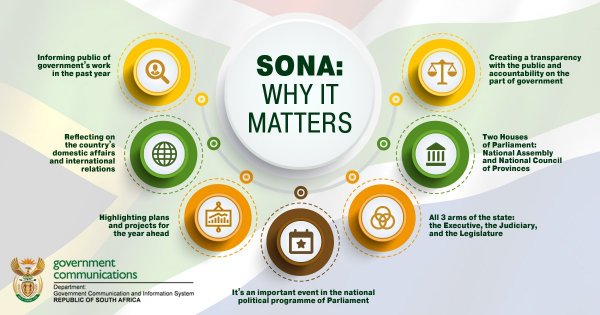
When is the State of the Nation Address happening? The State of the Nation Address (or SONA) will be delivered to a joint sitting of the two Houses of Parliament (National Assembly and National Council of Provinces) on Friday 16 February 2018 at 7pm. What is the State of the Nation Address? It is an annual address to the nation by the President of the Republic of South Africa as the Head of State which focuses on the current political and socio-economic state of the nation. What happens during the State of the Nation Address? The President sets out government’s key policy objectives and deliverables for the year ahead; It highlights the achievements and challenges experienced over the past year and maps the year ahead; It covers wide-ranging political, economic and social matters and considers the general state of South Africa; It deliberates on South Africa’s domestic affairs as well as its continental and international relations; and The full address is recorded in the Minutes of Proceedings. What happens after the State of the Nation Address? Political parties have an opportunity to debate, comment and raise questions on matters addressed in the President’s speech during a debate on the President’s State of the Nation Address. This year the debate is scheduled for Monday, 19 February 2018. The President will have the opportunity to reply to the debate on Tuesday, 20 February 2018. Live Stream SONA 2018 [video=youtube]
-
ALSI analysis - https://platinumwealth.co.za/insights/daily-analysis/alsi-global-stocks-sell-continues/
-
Capitec responded to a letter from Benguela Global Fund Managers on 1 February 2018. You may download copies of the correspondence below: Benguela Global Fund Managers Letter to Capitec Benguela_Letter_to_Capitec.pdf Benguela Global Fund Managers Letter Signature Benguela_Global_Fund_Managers_Letter_Signature.pdf Capitec response to Benguela Capitec_response_to_Benguela.pdf
-
News about Dash cryptocurrency
Platinum Wealth replied to Julin GYS's topic in Other Cryptocurrencies
New host - nice. What do you think about the current state of crypto, do you foresee decentralized exchanges being a major player in 2018, specifically 0x, Komodo and the likes? -
Viceroy Research: Capitec: A wolf in sheep’s clothing
Platinum Wealth replied to Spreadsheet Ranger's topic in Investments
Capitec Bank Holdings Limited - Market Speculation Following Viceroy Research Report On Capitec. Capitec Bank Holdings Limited Registration number 1999/025903/06 Registered bank controlling company Incorporated in the Republic of South Africa JSE ordinary share code: CPI ISIN code: ZAE000035861 JSE preference share code: CPIP ISIN code: ZAE000083838 ("Capitec" or "the company") MARKET SPECULATION FOLLOWING VICEROY RESEARCH REPORT ON CAPITEC Capitec received a copy of the Viceroy research report on Capitec at 10 am this morning. Shareholders are advised that Capitec has not been approached by Viceroy for insight into our business and none of their allegations have been discussed, tested or verified with management. We believe our corporate governance is strong and our communications and disclosures are, and always have been transparent, clear and to the point. On the face of it, the report is filled with factual errors, material omissions in respect of legal proceedings against Capitec and opinions that are not supported by accurate information. We are reviewing the report in detail and will respond to it in detail later today. 30 January 2018 Stellenbosch Sponsor PSG Capital Date: 30/01/2018 12:07:00 Produced by the JSE SENS Department. The SENS service is an information dissemination service administered by the JSE Limited ('JSE'). The JSE does not, whether expressly, tacitly or implicitly, represent, warrant or in any way guarantee the truth, accuracy or completeness of the information published on SENS. The JSE, their officers, employees and agents accept no liability for (or in respect of) any direct, indirect, incidental or consequential loss or damage of any kind or nature, howsoever arising, from the use of SENS or the use of, or reliance on, information disseminated through SENS. -
Bank Zero wins banking license
Platinum Wealth replied to Noobly's topic in News and Current Affairs
We also list it in the New JSE shares thread here. -
The supreme leader expects to win this year as well. Otherwise, there are bullets for you, your family and everyone who made no profit. Group - http://www.shareforum.co.za/competition/com_groups.php