Spreadsheet Ranger
-
Posts
1,979 -
Joined
-
Last visited
-
Days Won
32
Content Type
Profiles
Forums
Events
Articles
Everything posted by Spreadsheet Ranger
-

Satrix 40 exposure?
Spreadsheet Ranger replied to [email protected]'s topic in News and Current Affairs
Too damn much, I wonder what the weighing of Naspers is in the CTOP50? Does anyone know on what grounds these weighing are decided since I feel logically there should have been a cap? -
If I buy the S&P will I have duplication considering I already own DbxWD
-
Weaker rand hits Taste’s imports http://www.iol.co.za/business/companies/weaker-rand-hits-tastes-imports-2079221
-
Now that is going to rock!!!!!
-
Each time the price goes down I find I suddenly own a few more shares... Served by a Droid LOL !
-
Definitely, since it will make you lose 3 years off your life. This is a roler coaster. What do you guys think of buying all the exporters since a junk rating is pretty much guaranteed imho and the only companies I can see benfiting from R20/$ is raw exports?
-
The costs of establishing Starbucks and Domino’s in SA caused Taste Holdings’ interim loss to widen. The aftertax loss grew 16% to R34.4m during the six months to end-August, the franchisor reported on Wednesday morning, from the previous matching period’s R29.7m. Interim revenue grew 9% to R529m. Taste launched US coffee chain Starbucks in April, and its first two South African stores contributed R18m revenue during the reporting period. "All three trading stores are trading well ahead of our original investment cases and forecasts," CEO Carlo Gonzaga said in the results statement. "The Starbucks launch has been lauded by Starbucks around the globe and, as South Africans, we can proudly say that we have already set some records within this globally admired brand." The conversion of the group’s Scooters Pizza and St Elmo’s outlets into Domino’s had increased their average weekly sales by 17% since March, Gonzaga said. Domino’s grew to 85 outlets at the end of August from 74 at the end of February, and the chain has added a further two outlets since the reporting period. Besides fast food, Taste also franchises jewellery chains NWJ, Arthur Kaplan and World’s Finest Watches. "Same-store sales in the division increased an exceptional 25% over the prior period, which, combined with new-store growth, resulted in a system-wide sales increase of 27% to R316m," Gonzaga said. He said jewellery stores tended to generate about three-quarters of their profits during the second half of the financial year, which includes the Christmas period. Sous: http://www.bdlive.co.za/business/retail/2016/10/12/starbucks-and-dominos-widen-tastes-loss
-
BRIEF-Taste Holdings H1 core headline loss per share 6.2 cents Oct 12 Taste Holdings Ltd * Core revenue increased by 15 pct to r519.3 million for six months ended 31 August 2016 * System-Wide sales increased 7.25 pct to r858 million for six months ended 31 August 2016 * Core headline loss per share of -6.2 cents for six months ended 31 August 2016 * Same-Store sales in luxury goods division increased by 25 pct for six months ended 31 August 2016 Source text for Eikon: Further company coverage:
-
The official Medium Term Budget Policy Statement 2016 thread. Gordhan would like your ideas on: a) What are the three things that government does very well? b) What are the three things that government should stop doing? c) What are the three areas that government spending should be directed to? d) How can SA achieve inclusive economic growth? Finance Minister Pravin Gordhan will present the Medium Term Budget Policy Statement (MTBPS) to Parliament on 26 October 2016. Lock-ups have been arranged for journalists in Cape Town and Pretoria, allowing access to the Budget documents prior to the Minister’s address in Parliament. The information contained in the documents will be under embargo until Minister Gordhan tables the budget in Parliament. The Twitter handle for the MTBPS is: @MTBPS2016 & #MTBPS2016
-
I hope they get their bottoms in gear. Someone needs to send them a strongly worded E-mail.


-
My average is 202 cents down from 350 cents. I do not have money anymore to throw at this thing (Sad Face)
-
This guide is intended for small business owners who wish to help promote Bitcoin by accepting it as payment for goods and services. I am going to type/write this with the assumption that you have a small business selling goods and services and simply wish to accept Bitcoin as another legal way to pay, and that you intend to pay taxes on your Bitcoin income just like any other income be that cash, eft or card payments. With Bitcoin being touted as a way to conduct anonymous transactions and as way to compete with government currency, many small business owners wonder what's the right way to accept and account Bitcoin, or if it's legal or ethical, or whether and how they should pay taxes on income received through Bitcoin. As far as I know, Bitcoin isn't yet formally recognized by governments and authorities as a "currency" (http://www.treasury.gov.za/comm_media/press/2014/2014091801%20-%20User%20Alert%20Virtual%20currencies.pdf). But in practice, Bitcoin is likely no different than accepting payment in other forms, such as cash, or gold, or gift cards or foreign currencies. Starting to accept Bitcoin for transactions If you expect that the number of people interested in using Bitcoin is small, you might simply start by posting a sign or a note: "We Accept Bitcoin", and ask people to contact you directly in order to make a payment. Even if hardly anybody uses Bitcoin as a payment method, you're helping Bitcoin in two ways: one, by increasing awareness, and two, by making your customers more willing to accept Bitcoin as payment from others in the future, because now they know somewhere they can spend it. Utilize a merchant solution If you sell things on your website (goods or services), you'll want to use a Bitcoin merchant solution to accept the Bitcoins, I would suggest payfast if your margins allow it due to payfast being completely automated and tailored for South Africa. If you are or have a developer that runs your website, it would be most ideal to use the API from blockchain.info (https://github.com/blockchain/api-v1-client-php/blob/master/docs/wallet.md) that way you do not have to pay additional transaction fees that traditional merchant solutions have. If you operate a traditional brick and mortar shop your clients can pay either via QR codes directly into your companies wallet or you can register for a Bitx.co account and have a tablet or smartphone at the business linked to the bitx.co app and accept payments on the fly whilst having a detailed audit trail of each and every transaction. Although I personally suggest using bitX.co it should be noted that I had tremendous success using https://airbitz.co/bitcoin-wallet/ as a Bitcoin Point-Of-sale application in some of our brick and mortar shops. You will still need a Bitx.co account since that acts as an exchange that enables you to convert your bitcoins into ZAR and then you can declare that money to Sars. Accounting When a customer makes a payment, you might simply issue a credit to their account. Ideally, you want to enter it in a way that suggests you received a payment. You could consider entering it as a "discount", but you may want to consider whether this inappropriately disguises the nature of the transaction. If on the other hand, you're giving "discounts" for Bitcoins, but then you are selling the Bitcoins for currency and then counting that as income, then chances are good that your calculation of income is making up for it. Ask your accountant. Businesses that offer gift cards If your business sells gift cards or gift certificates, you may find that the easiest way to accept Bitcoin is to accept it only for the purchase of gift cards, and then require the gift cards to be used for actual purchases of goods or services. This way, the accounting practices you already have in place for processing gift cards can be put to use. The accounting for Bitcoins would then be minimized to tracking sales of a single SKU. This method is also ideal for retail food establishments and convenience stores, where the payment of Bitcoins through a mobile phone for a small daily food purchase might be cumbersome or disruptive, especially in front of a line of other customers. Bitcoins in this case would be best used to reload prepaid cards that can then be swiped at point-of-sale. If you don't accept gift cards, but you already accept credit cards through a swipe terminal, consider the possibility that you could add a retail gift card system through the swipe terminal you already own. Setting Prices Some shops set prices based on the current market rate (bitx.co has South African rates) at the time the price quote is presented to the customer. Personally I would suggest to use some form of moving average that way your price does not fluctuate too much considering Bitcoin is quite a volatile currency at the moment. Paying taxes on Bitcoin income Tax compliance is a topic of concern for small businesses. I am not an accountant nor a lawyer, and can't give legal or accounting advice. But in many respects, Bitcoin transactions work very much like cash. Just like Bitcoin, cash is anonymous and doesn't leave a paper trail, yet is widely used in commerce every day. Ask yourself how you would handle a cash transaction. Do you accept cash transactions? Do you normally pay taxes on cash transactions? The answer for Bitcoin should probably be the same. If you opt in to use bitx.co then the accounting would be easier in my opinion since you can convert the bitcoins into ZAR in your bank account and that can then be declared with your income, if you instead opted in to use an anonymous wallet and never convert your bitcoins into ZAR again then the onus is on you to declare your bitcoin holdings just like you do with cash.

- 1 reply
-
- 1
-

-
Difficult times thinking should I continue to buy more TAS or should I rather just sit now with the average purchase price of R2.01
-
Taste Holdings sees H1 HLPS narrowing to 8.5-9.5 cents Oct 4 Taste Holdings Ltd * Sees headline loss per share for the 6 months ended 31 august of 8.5 cents-9.5 cents versus loss of 10.5 cents year ago * Sees core headline loss per share of 5.8 cents to 6.6 cents for the 6 months ended 31 august versus profit of 0.1 cents year ago Source text for Eikon: Further company coverage: Sous: http://in.reuters.com/article/idINFWN1CA0GN
-
JOHANNESBURG – National Treasury has proposed a number of tweaks to regulations governing the use of tax-free savings accounts (TFSAs), but remains unwavering in its stance that performance fees will not be allowed. It previously indicated that the nature of these fees was uncertain. It also argued that performance fees could fluctuate quite a lot and could become rather costly, particularly for uninformed investors. It seems performance fees do not adhere to the principles of simplicity, transparency and suitability set as requirements for inclusion in TFSAs. National Treasury on Friday proposed amended wording to the regulations to make it absolutely clear that no performance fees are allowed in these products. It said the policy intent around the treatment of performance fees has been communicated consistently since day one. “Performance fees may not be charged in TFSAs nor in any of the underlying funds in which the TFSAs are invested.” Tax-free savings accounts were first introduced on March 1, 2015 in an effort to reduce the financial vulnerability of South Africans. Individuals are allowed to invest up to R30 000 per annum in one or more of these accounts (collectively) up to a maximum of R500 000 over their lifetime. All the investment returns earned in the accounts are 100% tax-free. While the money can be withdrawn at any point, the benefit of these accounts is only really unlocked in the very long term. Investors will be allowed to transfer existing savings in a TFSA from one product provider to another from March 1, 2017 following the publication of a postponement notice in the Government Gazette late in September. While this was initially planned for March 1, 2016, it was postponed to November 1 during the Budget in February and has now been deferred by another four months. National Treasury said the postponement of the transfer date would allow product providers some time to adjust their systems after the final regulations were published. Some of the proposed changes aim to address compliance issues and the administration of fees. As a principle, the money in tax-free savings accounts should be available to investors for any short-term needs, including emergencies, large expenditures and asset purchases and the ability to access the money “should not be unduly restricted”, it said. It conceded however that the current rules that offer access to amounts within 32 days for products with a fixed term and seven days for those without a fixed term appear to have restricted the ability of providers to offer fixed term deposits. Only a few fixed term deposit products offering higher interest rates are available. “In balancing the above two interests, National Treasury proposes a relaxation of the rules on accessibility, which would allow product providers discretion to only allow individuals access upon the maturity date of the product. “Product providers can, however, still allow investors to access these funds before maturity, as is the case with regular fixed term deposits. The current rules that limit the exit penalty on early withdrawals will remain to safeguard investors against excessive penalties when withdrawing or transferring before maturity.” National Treasury also proposed that product providers would be required to notify the Financial Services Board one month in advance when a new product would be launched. “The FSB will be able to review the features of the product for compliance with the Regulations and endeavour to respond to the product provider within the calendar month.” Product providers won’t be forced to wait for the regulator’s response for more than a month, but the FSB may make certain queries related to compliance following the launch of the product. Source: http://www.moneyweb.co.za/mymoney/moneyweb-tax/tweaks-to-tax-free-savings-accounts-proposed/
-
Source: http://www.fin24.com/Tech/News/who-inherits-your-selfies-facebook-pics-when-you-die-20161003
-
5 things you have on your desk right now
Spreadsheet Ranger replied to Platinum Wealth's topic in General Chat
1 Canon 550D 2 a kitten 3 class of milk 4 earphones 5 Pen and Paper -
From - https://twitter.com/Richards_Karin/status/781832780460220416

-
I use sites that offer free linux distro's to save money
-
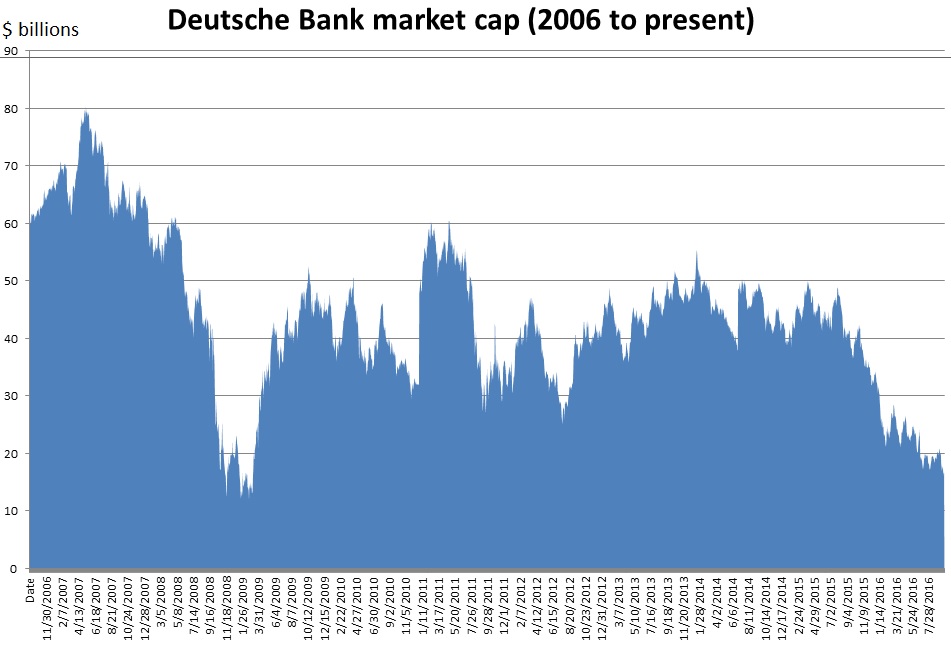
Deutsche Bank rout deepens: Shares plunge below €10 for first time ever, as FTSE 100 tanks towards 6,800
-
2008 in the making


-
If I has that money today this would be my investment: NFEMOM - 50% Ashburton MidCap ETF (ASHMID) - 25% Rolfes Holdings Ltd - 10% ( Sell @ >500 cents then buy CoreShares Property Top Ten (PTXTEN) ) Taste Holdings - 15% ( Sell @ 600 cents then buy NewFunds MAPPS Growth ETF (MAPPSG) ) Some duplication here and there, but looking at the different weighings I am comfortable.


-
Cape Town - Gauteng residents might very well ask why they have to pay e-tolls, while residents in the Western Cape have escaped the same fate, says Pieter Conradie of law firm Cliffe Dekker Hofmeyr. "Given the latest judgment in the Supreme Court of Appeal in the matter of the SA National Roads Agency (Sanral) versus the City of Cape Town, Capetonians do not have to pay toll tariffs," said Conradie. In contrast, Gauteng residents have had to pay e-tolls since a 2013 judgment by the same court. "There were two judgments in the same court, but with two different results. Why? In both cases, the applicants had to apply for condonation for the late filing of their applications. Yet the one, the City of Cape Town, was successful in its condonation application whereas the Organisation Undoing Tax Abuse (Outa) did not succeed. This is despite the finding, in both cases, that the delay in bringing the court cases was unreasonable," explained Conradie. Read full article - http://www.fin24.com/Economy/why-must-gauteng-pay-e-tolls-if-capetonians-spared-20160929
-
The Giant Flag is a legacy project of vast proportions, a celebration of the spirit of South Africa, her land and her people. We’re building a flag made up of millions of coloured desert plants, and a four-megawatt solar field, on a tract of land that was previously completely barren. Effectively viewable from space and the size of 66 soccer fields, the Giant Flag will not only claim its place as a natural wonder, but also as a new model of economic stimulus for previously disadvantaged communities. Job creation, clean energy and tourism come together in a world first green innovation project! Check the flag by hovering over it - https://www.giantflag.co.za/

-
How is that for a click bait heading CAPE TOWN – It would be a “natural development” for international retail group Steinhoff to take over Shoprite, Africa’s biggest supermarket chain, South African retail tycoon Christo Wiese told Reuters. Wiese is the largest shareholder in budget store Shoprite as well as lower-end furniture, apparel and household goods retailer Steinhoff. Bringing the two together would allow him to add groceries to his sprawling discount empire. The merger, if it happens, would also pull together Wiese’s retail assets under one roof following Steinhoff’s nearly $6 billion acquisition in 2014 of the magnate’s budget clothing retailer Pepkor and create a global retail giant worth at least R400 billion ($30 billion). “People will speculate about that,” he told Reuters in a rare interview on Tuesday at his modest offices overlooking factories in the dusty northern Cape Town industrial suburb of Parow. “People know that I am 75 years old, and I fortunately have a son who is in business with me, but as a family we are continually looking at consolidating our business interests. So, it would be, in a way, a natural development.” Since Steinhoff’s Pepkor acquisition, some analysts have wondered if Wiese, along with Shoprite’s chief executive Whitey Basson and Steinhoff’s Markus Jooste were working on a tie-up. Wiese, who describes himself as a “realist, pragmatist”, started Pepkor in the 1960s, in Upington on the southern edges of the Kalahari desert, after spotting an opportunity to bring cheaper clothes to the poor. He then transformed budget chain Shoprite from a six-store company in the 1970s to one with hundreds of stores across Africa, from South Africa to the Democratic Republic Congo, dwarfing rivals including Wal-Mart’s South African unit Massmart . His discount strategy, which also now includes investments in clothes retailer New Look, has catapulted him to the cover of Forbes magazine as one of Africa’s richest businessmen. “Why is it so successful? …The people who earn a lot of money are a small portion and then at the base is where your mass market is, where people have limited disposable income and we’re aiming at that market,” he said. Wiese studied law in Stellenbosch, a close-knit town dominated by Afrikaans-speaking whites, but lives in Clifton, an area of Cape Town overlooking the Atlantic Ocean with some of South Africa’s most expensive properties. He owns a high-end vineyard near Stellenbosch, an area dotted with executive golf clubs, but said he “finds playing golf boring.” New Look Wiese is also a top shareholder and board member in South African investment heavyweight Brait, which last year bought gym chain Virgin Active, a relative outlier in his business model as it targets middle-class consumers. More in line with the low-cost theme, was Brait’s purchase of no-frills retailer New Look. Wiese said Brait’s “most obvious” growth trajectory was through its existing businesses that also include UK supermarket chain Iceland Foods and South African staples foods maker Premier. “There is plenty of scope (to grow). It’s got a strong management team and the biggest scope lies within the existing businesses. New Look for instance, our clothing retail operation in the UK, has identified China as a major growth area,” he said. Wiese said New Look was looking to open 500 stores within three years in China, where it already runs 90 outlets. “China is an enormous market,” Wiese said, describing the New Look’s store expansion plan as a “drop in the ocean” given the size of the Chinese population. Virgin Active, which has taken top spot market in Italy and its biggest chain is located in South Africa, has identified Asia-Pacific as the next growth market thanks to a growing population of health-conscious consumers, he said. Wiese was optimistic for the outlook for Europe despite gloomy economic forecasts but was cautious about the idea of snapping up cheaper assets in Britain following its June vote to leave the European Union. “Undoubtedly it does offer opportunities but there are greater risks because none of us know how it (Brexit) is going to play out,” he said. “There are studies that show that by 2040, Britain will have a bigger economy than Germany and a population of over 80 million people, that’s a market you can’t ignore.” Political damage In South Africa, several businessmen, including the outspoken chief executive of gold miner Sibanye has called for President Jacob Zuma to resign after a series of scandals. Wiese said as a businessmen rather than a politician, he would like to stay out of politics. However, he said that the country’s leadership was hurting Africa’s most industrialised economy, which is expected to grow below 1% this year. “It is clear to a blind man that today the top leadership in the government is seen as a problem. It is not helping our economy. That is a fact of life,” he said. But Wiese also dismissed suggestions by some analysts that he was looking to preserve his wealth by moving assets abroad during the political turbulence that has also drawn in Finance Minister Pravin Gordhan. On the contrary, he said he expected business to continue to expand, including its interests in South Africa, with Virgin Active for example having its head office in London but earning more than 60% of its Ebitda, or core profit, in South Africa. “There is no bias to disinvest – in fact the very opposite,” he said.