SaurusDNA
-
Posts
239 -
Joined
-
Last visited
-
Days Won
54
Content Type
Profiles
Forums
Events
Articles
Everything posted by SaurusDNA
-
Today is a perfect example of why CTOP50 is better than STX40. The all-share index gained 0.10% today, but the top 40 index dropped by 0.03%, purely because Naspers dropped 1.41% during the day. On the other hand, the CTOP50, which has a cap of 10% on any stock, gained 0.28%. Same shares as T40 (+10) but with more equal weightings. With Asian markets faltering in the last few weeks, I'm so glad I have CTOP50!
-
Great idea. The market has returned roughly 15% year on year since forever, which is higher than the average bond rate. That, together with the tax savings, in my opinion, topping up your wife's TFIA is the way to go. It's an interesting mix you've chosen there. I think I see what you're trying to do. You've matched the market cap weighted indexes with the equal weight indices to balance growth vs risk. The portfolio you've chosen for your wife is rock solid, and should certainly match the market. I like the way you're thinking with your choices - I haven't actually thought of mixing ETFs up this way before. With the choice between ASHT40 and STX40, ASHT40 is much cheaper than STX40 for the exact same index. The TER for ASHT40 is 0.19% and for STX40 it's 0.45%. That means SATRIX is more than double the costs for the same index! Compounded over 25 years, the difference equates to a lot of money. For this one, ASHT40 beats STX40 hands down. Plus, you already have a lot of SATRIX in your portfolio, and it's always good to balance your brokers too, just in case... To compliment your own portfolio, which already has STXWDM, I'd definitely go for ASHGEQ. ASHGEQ basically tracks the global market 100% and is the most solid of all the global ETFs and will match the global market pretty much 100%, However, to beat the market just a little, and since you already have STXWDM in your portfolio, I think I'd add STXEMG and STX500 (the S&P500 index, which has outperformed the global market for years) to add some extra USA exposure. Since 2015, emerging markets have had better growth than developed markets, with EMs having 4.5% GDP and DMs having only 2.25%. Much of the EMG success is due to China. Some analysts think China won't be able to sustain their growth, but others say China is the way of the future. I think your choice of adding EMG here as well should depend to some extent on how you think China will do. Maybe consider: Local CTOP50 ASHT40 (NOT satrix in this case) PTXTEN Global Some global mix suggestions: Mix 1: ASHGEQ (Globally balanced + some emerging markets) STX500 (USA S&P500) STXEMG (Emerging Markets) Mix 2: SYGWD (60% USA + some global) STXEMG (Emerging Markets) SYGJP (Japan) and/or SYGEU (Euro stocks) Mix 3: ASHGEQ (Globally balanced + some emerging markets) SYGWD (60% USA + some global) SYGJP (Japan) and/or SYGEU (Euro stocks) Mix 4: Only ASHGEQ, since it really is well balanced.
-
Yes, SYG4IR has been very disappointing so far, but I'll keep buying for another year and see what happens. I have a feeling your PropTrax 10 will have a record year, since SARB may cut interest rates several times this year. I'd love to have it in my portfolio too, but I'm out of space!
-
For TFIA, almost all the stockbrokers charge a standard 0.25% fees per purchase. OST for TFIA is no more expensive than any other and is very good. Only its trading platform is more expensive, but for TFIA, it's also worth considering. Unit trusts are still far more popular than ETFs in this country, but abroad, ETFs are more popular because they are constantly outperforming Unit trusts, because they allow intra-day trading while unit trusts don't. I have a feeling if you stick it out, your Allan Gray and Alexander Forbes are going to go the ETF way of long-term investing as well. I prefer Option 1, but it will cost you a percentage or two of your already existing portfolio if you move (once it's allowed of course). Why not, for now, keep your Easy Equities as they are and contribute there until end of February to keep the accounting simple, and then start your new tax year's TFIA from 1 March onwards putting your money into a TFIA at ABSA or OST until the move is allowed?
-
I've just set my future TFIA payments for the year, and my R33000 per year split (R2750 p.m., although I'm hoping it will increase from March) will be as follows: Local (37.5%) STXIND: 12.5% STXQUA: 12.5% CTOP50: 12.5% Offshore (62.5%) STXEMG: 19.0% ASHGEQ: 18.5% GLPROP: 12.5% SYG4IR: 12.5% My rationale is as follows: I went only 37.5% in local ETFs as my stocks portfolio is mainly in local shares, and over 25 years, I like the diversification of global markets. STXIND: It excludes banks and mines, so is largely unaffected by the Rand value or political noise. It performs purely on the value of its companies. Also, it's been the top ETF averaged over 10 years, and I don't see any reason for it to be any different in the future. STXQUA: A new ETF. Great companies, chosen for quality rather than market cap. High dividends as well as growth, so the upward trend should remain constant, ever in a bear market. Might underperform the T40 in a prolonged bull market run though, since it focuses more on dividends than growth, but should outperform the T40 in a fluctuating market. Still, so far, since inception, it has outperformed T40 on growth too, so I'm not complaining! CTOP50: Companies chosen for market cap (long term stability) as the third prong of my local shares balance. Since I have STXIND, I did not want to duplicate my massive exposure in the top 5 like Naspers by having STX40 as well, so I went for a more equally weighted ETF here to balance out the INDI. I don't like the strictly equal weight ETFs like CSEW40 because they lose out on extended bull runs because companies in these ETFs are not allowed to exceed 2.5% even if the share sky-rockets by 1000%, but this one (CTOP50) has more flexibility than strict equal weight ETFS while minimizing any risk. STXEMG: I think emerging markets will outperform developed markets in the next 10 years. Hence the highest allocation to this ETF. ASHGEQ: ASHGEQ rather than S&P500, because there's too much instability in the US at the moment. I'm worried about Trump and the political situation with North Korea. ASHGEQ may slightly underperform the S&P500 (or it may do better), but at least my money's safe! GLPROP: Had to have some property... SYG4IR: My high-risk ETF. It may never take off, or it has the potential to sky-rocket. This is my 12.5% gamble that may lose me 12.5% or may make me very rich! :-)
-
It's my own fault really. I waited too long to confirm the upward trend and got stuck in the typical "buying at the top" trap. I should have known better!!!
-
It was terrible timing on my part. I bought at 74c per share in mid July when it was looking really promising, only to cut losses with a trailing 18% SL two months later... :-(
-
I'm nervous about no-name-brand banks. African bank didn't do well. I thought its rebirth as African Phoenix (AXL) would do well but I lost money there too. At least Discovery bank has the backing of a financial giant behind it.
-
I'll be waiting with my money ready for its listing. If it does as well as Capitec, we will be able to retire comfortably... :-)
-
For that matter, this is also a serious flaw on your logic in the original post: If you took the interest from the tax free investment and reinvested it in the normal savings account , you're going to make R7,200 no matter what because the exempted amount is capped, no matter what the source is of the money. If you left it in the TFIA, it would have scored tax on all it's growth forever. You are going to make an exact amount R7,200 if you put in new cash into a normal investment account as well, because its the cap for capital gains exemption, so there is no second saving on re-investing the tax free money. The only thing that happens if you withdraw the TFIA interest and reinvest it for the capital gains benefit, is that you lose ALL the tax free benefit of the growth of that interest, because you would have made R7,200 anyway.
-
The TFIA is much, much better, because the tax savings is uncapped. Only the contribution is capped, but theoretically, you could make a billion Rand tax free if you have a shares that grow by a million percent, for example. On the other hand, with CGT exclusion, the amount you're going to save on tax is capped at 18% of R40,000 (ie. R7200), irrespective of how much more you make. The TFIA is therefore the clear favourite for growth over the long term - because you automatically have 20% of your total growth re-invested each year, compounded for many years - not just the tax saving on R33,000.
-
The TFIA account is going to get R33,000 put into it per annum irrespective of whether it's from my monthly salary or from my RA tax rebate. Because of the R33,000 limit, it makes no difference where the money comes from. That is simply an accounting matter, but the total tax saving (in Rands) remains the same irrespective of whether it's tax free RA money that has been re-invested or salary money that is being invested in TFIA.
-
Here's a illustrative screen capture of a graph from Standard Bank's online tutorials (albeit from an earlier tax year when it was still a 30,000 annual limit). The tax benefit only really starts making a noticeable difference from 5 years into the investment, but at 25 years, when the lifetime contribution is fully utilized and the tax benefit compounded, the difference in returns is huge.

-
Without talking tax law, there is one gaping hole in the logic simply due to pure mathematics: Unless you have half a million invested at 10%, it will take more than six months to make the R23,800 interest. But let's say you somehow do make R23,800 in 6 months for example, which will enable it to be invested in step 2 for the next 6 months. Then, you are taking a maximum of R23,800 (as per the first few words of your statement 2) to invest for the next six months to make the R40,000 CGT exclusion amount. Flaw 1) This means in order for this to succeed, irrespective of your initial investment, your R23,800 investment would have to be earning interest at 336% p.a. (over the six months) to make the R40,000. Flaw 2) If you were in the position to have half a million to be able to make the R23,800 interest in a few short months, and assuming you were able to get 336% interest on that half million (at the usual 20% tax rate), thus making approximately R1.7 million interest in six months, then would you really care about the R8,000 saved by the double tax saving?
-
I'd bet money Dis-Chem will grow at least 45% this year. It's my biggest individual stock at the moment. It's a tough choice between Clicks and Dis-Chem in that sector, but I think Dis-Chem is going to sky rocket. Clicks may be close to it's true value, I feel; not that I think it will drop, but I think it's growth might slow down a bit - to maybe 15%-25% for 2018. Obviously, the fact that several of the directors sold a ton of their Dis-Chem shares last month will slow its progress a lot, but I believe by April Dis-Chem share prices will be as green as the grass of Ireland. It's definitely my pick for 2018.
-
I just bought a few Long4Life at R5.07 on Wednesday, after my wife came home with some new Sorbet products and was totally raving about them. I've been thinking about buying L4L again for a while now , and coupled with the recent upswing in its share prices, I'm finally convinced that it will do really well this year... :-)
-
I think this is a really good mix now. Looks well balanced with great potential. I think this year will be an excellent one for STXQUA, STXEMG and INDI25 in particular, so I like the higher percentages that you've allocated to these right now. You could always buy more property in the future when it starts to pick up.
-
Yes, I suppose so. I was just thinking that I might have too much in global ETFs at the moment. If you consider that Naspers is already a rand hedge, I might have too little locally. Most of the ETFs are red because I've just re-balanced and sold my duplicated ETFs to buy new ones, but I'm hoping it won't take too long for them all to turn green... If you don't count the rhodium, I have 70% global and 30% local. Too much global?

-
I think your STXQUA gamble might just pay off. When Naspers and Steinhoff crashed, STXQUA stayed very green. It has a lovely mix of companies and I personally think it has a bright future. I see you've dropped SYG4IR. It's done dismally since inception. I hope it recovers soon, but I am disappointed so far.
-
I'm an investor, not a trader, so in general, I don't do short term buy and sells - I choose companies with good trends over 10 years, if possible, with the occasional wildcard such as Steinhoff (I bought a few of these at 488c). I regularly try and revise my strategy and these are my two choices at the moment: Option 1) Buy and hold indefinitely with a trailing stop loss at 20%. Option 2) Buy and hold with a trailing stop loss at 20% and a "sell 50% of stocks at 40% profit" order, while letting the other half run. I'm still reluctant about using a "take profit" order, although many say this is the way to go, and I'm still most likely going to end up choosing option (1), but I'm interested on hearing your thoughts on this. Question 1) What is your opinion on "take profits" (or a portion thereof) as compared to "hold indefinitely" (for the investor, as opposed to trader), and what has worked for you? (As an investor, I'm talking about larger margins such as 20% trailing stop loss and 40% profit-taking, not the small margins used in day to day trading.) Question 2) What is your trailing stop loss percentage set at in a "buy and hold" strategy if you use stop losses? It seems the literature is split between 15% and 20% as being the optimal percentage for "buy and hold" stop losses - (Reference: https://www.quant-investing.com/blogs/general/2015/02/16/truths-about-stop-losses-that-nobody-wants-to-believe), although it is clear that the use of a wide trailing stop loss margin gives better returns than using no stop loss in "buy and hold" in the long term, provided it is 15% or larger, so wondering what you think and what has worked for you.... As the saying goes, "Theory guides, experiment decides.", so I'm interested in hearing what works best for investors on this forum.
-
Bandit is the expert on ETFs here, so I would wait for his comments before taking any action, but my immediate observations are: 1) Ashburton Top 40 is the exact same index as Satrix Top 40, but with lower fees, so I'd definitely recommend going Ashburton rather than Satrix for this one if you choose a Top 40 Index. But... 2) CTOP50 has much lower Naspers exposure than either Top 40 index, so if you're doing INDI also, then you have so much Naspers exposure (INDI is 40% Naspers), that either Satrix or Ashburton Top 40 (which are both also 20% Naspers) would be almost be duplication and put tons of risk in one company and you're at risk of a Steinhoff type collapse of a large chunk of your investment if something goes wrong with Naspers. If you're going to keep INDI, then I'd definitely go for CTOP50 rather than either Ashburton Top 40 or Satrix Top 40. Without INDI, I'd go for Ashburton Top 40. 3) Since you don't have mid-cap in your investment, CTOP50 is also better than a Top40 index, since it has some mid-cap exposure as well. 4) If you have STXWDM or ASHGEQ, then S&P is duplication. Remember, however, that you can only trade within the TFIA, and can't withdraw and then deposit again, so be careful if you sell S&P that the money doesn't get paid out to you but gets reinvested right away. 5) STXWDM is 60% US markets, whereas ASHGEQ is much more balanced globally, so you should decide on whether you think US will outperform the rest of the world under Trump before deciding on which of these two to buy. ;-) 6) Just out of interest, why NFTRCI? This is very low risk and will give you an almost guaranteed 6-7% return, even in a bear market, but certainly no higher. I'm not saying it's bad as part of your portfolio - if the JSE crashes, this one will probably be the best to have, but I'm just wondering if you have a bleak outlook on the economy this coming year? This one can sometimes be frustrating as it will take you over three months just to recover your fees, due to its straight line 0.5% per month return. I bought it once and regretted it and sold it after a few months for a few cents above what I bought it for. 7) For your local mix, also have a look at STXQUA (Satrix Quality Portfolio) which has done remarkable well since its inception compared to the other indices, and is a different basket of companies from the above, chosen on performance rather than market capitalization. 8) In general, Satrix is expensive with fees compared to others such as Ashburton or Sygnia. If you decide to go for STXWDM rather than ASHGEQ, then have a look at SYGWD as a cheaper alternative. Overall, though, it looks good. With your preferences I'd go for: Local: CTOP50 STXIND (And maybe STXQUA also with your mix to balance performance and market cap.) Global: ASHGEQ (or STXWDM or SYGWD) STXEMG GLPROP SYG4IR That's my 2c...
-
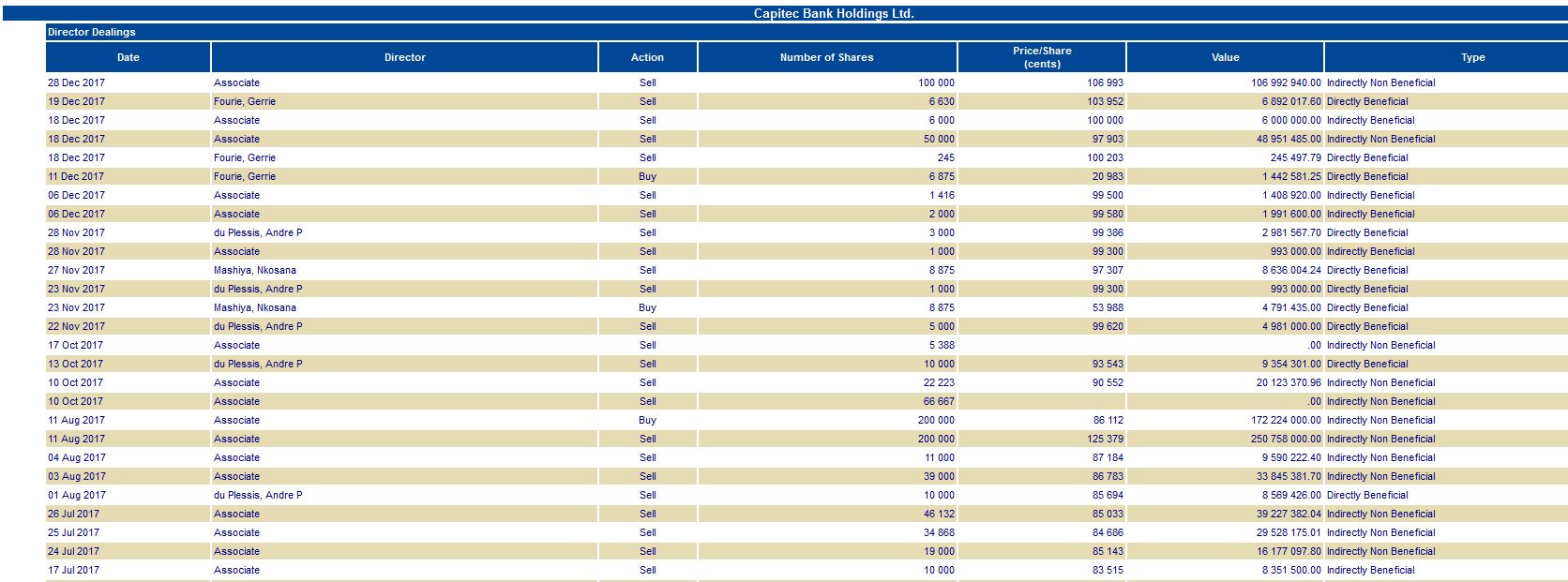
What worries me is the massive sell-off of shares by directors lately. It gives the impression that Capitec is overvalued at the moment. Looking at the Directors' dealings over the past six months, almost all trades by directors are sells, and large volumes too...

-
Hmmm... It seems like SB is the most expensive. But do the others also provide services such as free analysts forecasts and consensus and detailed research etc.?
-
I'm with Standard Bank Online Share Trading and I was just wondering how the fees structures and services compare with other brokerages and if you're happy with your broker. Standard Bank has the following fees structure: Equities Monthly account cost: R90 0.50% per trade with a minimum of R90 + VAT STRATE fee: R10.71 So the minimum fee per trade is R114.81 before transfer fees. TFIA 0.25% + VAT (No minumum fee) CASH Interest earned on cash balance is 5.68% What I like about SB Online Share Trading: - It does what it's supposed to do and works well and is never down (as far as I know). - Cash transfers to and from my Standard Bank accounts are instant. - Fast and efficient brokers for phone trades - phone is normally answered within 10 seconds. - Detailed reporting such as annual and lifetime TFIA balances, even those not on the share trading platform (done by ID search). - Free detailed analysts forecasts and consensus and detailed research on almost all stocks - Instant SENS and news notifications for all stocks on watchlist What I don't like about SB Online Share Trading: - 25c fee for every sms including logging on. - 16c for every live quote. It's not so much he 16c that I'm not happy with - it's that you do get a R10 balance for quotes and sms's included in the monthly fee, and Standard Bank advertises on their cost structure that you get an additional R5 for every trade, but to date I have never received the additional R5. Also, it charges you the 16c live quote fee even when the market is closed. My rating of Standard Bank's Online Share Trading: 4.5/5 I would love to know how this compares to other brokerages, so post here if you'd like to give your thoughts, comments or fees structure of your broker.
-
Luno does. A deposit at Luno takes about 5 minutes to reflect. If you withdraw before 8am at Luno, the money will be in your account by 9:05 am. I'm with Standard Bank, and Luno has always been lightning fast as far as deposits and withdrawals go. On the other hand, in my experience, ICE3x takes up to a day a day for deposits and up to a week to get your money out. But then again, Luno doesn't have LiteCoin, so ICE3x is the only real option for that...