



SaurusDNA
-
Posts
239 -
Joined
-
Last visited
-
Days Won
54
Content Type
Profiles
Forums
Events
Articles
Everything posted by SaurusDNA
-
Oh yeah, oh yeah, oh yeah!!!

-
Just blew a head gasket on my car and now have to sell some shares to pay for it... :-(
-
You're right - it is high. It's the same TER as the low volatility, which re-balances quarterly, so it doesn't make sense, although in the video, they say the TER will be reassessed and adjusted after a year once the actual costs are known.
-
Thanks Simon. That video was extremely instructive. Much appreciated!
-
To me it makes sense that it re-balances only twice a year. The ETF is made up of "undervalued" shares weighted by how much they are undervalued. As they start growing and becoming less undervalued, the weighting becomes less. As soon as they reach "fair" value, they no longer qualify to be in the ETF and get kicked off. At least in an extended growth run, the six months will give the ETF the benefit of reaping the growth of that share, ratrher than kicking it off immediately as it reaches "fair value", as would be the case with frequent re-balancing. My problem with this methodology is that the biggest weighting is given to the most undervalued shares which have become that way by a continued down or flat trend, which is bad. As soon as it starts growing (which is desirable), it becomes less and less undervalued, so it becomes weighted less and less as it grows more. This penalizes shares that are performing. Maybe I am understanding the methodology incorrectly, but this is what I understand from what I have read. I wish we had an expert around that could clear things up regarding the methodology.
-
Oooh, the value one looks attractive! :-) How does it work though - if it's made up of undervalued shares, as soon a component share recovers to a calculated "fair" value (for want of a better word), then it gets kicked off the ETF? And how is "fair value" decided? Especially since 28% of the ETF is commodity shares, which are cyclic? It sounds really good, but I'm struggling to get around the technicalities.
-
For the first time ever, hodling my crypto's is starting to make me nervous. Normally, at this price, I'd by a few extra Rands worth, but this time around, I don't feel I should... :-(
-
I think the performance of the fund is important. But remember that performance now does not mean performance in the future. Several years ago, when I had my own business, I put all my RA contributions into a Liberty RA, because they were the best then. Now I regret not diversifying. On the other hand, if you're with a fund manager like Alexander Forbes or Allen Grey or Coronation, they will spread the risk for you, so in this case, adding more to your existing RA is fine. I'd rather pay 1% for a fund manager rather than drop to 0.7% for a single SP exposure.
-
I agree with LentilSoup - Nerina Visser gets my vote too.
-
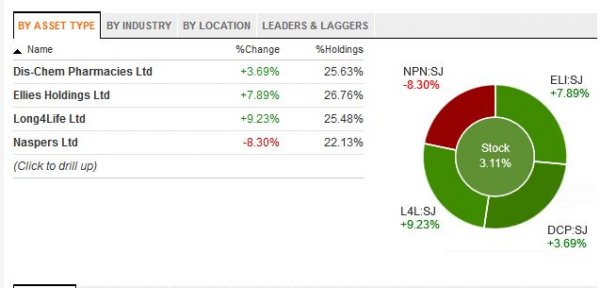
This is the performance since 20 December when I sold everything else and bought these four: For 2 months returns, especially considering the crash, I think it's not bad! ;-)
-
I agree with Noobly about Long4Life and PSG for long term growth. I own L4L and very happy with it. I don't own PSG yet, but am considering it as a possible purchase for later this year now that my Capitec is gone (that fateful morning I woke up and my 18% trailing stop-loss triggered all my Capitec to sell after the Viceroy report.) I'm also thinking long term and I own four stocks at the the moment: Naspers (NPN) Dis-Chem (DCP) Long4Life (L4L) Ellies (ELI) I sold everything else and put it into these four. The stocks that I don't own at the moment that I'm watching very closely with an eye to buying are: PPC (PPC) Shoprite (SHP) PSG (PSG) To start an ETF portfolio, I'd go with with Bandit's suggestion of Ashburton Global 1200 (ASHGEQ) and NewFunds MAPPS Growth ETF (MAPPSG). If you prefer higher risk and equities only, then ASHGEQ and Coreshares Top 50 (CTOP50).
-
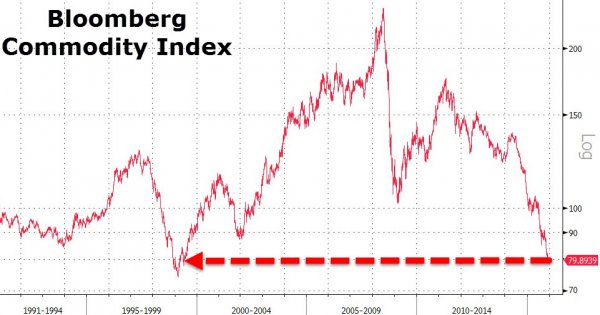
That is true. But commodities are not buy-and-hold stocks because their price fluctuates wildly. They are cyclical and their behaviour looks like a cosine wave or an oscilloscope. Their average price over 10 years may be flat or even down. A lot of money can be made with commodities in a market like ours is at the moment, but it requires hands-on active management. Go away from your screen for a few days and you may find the price has changed by 20%. Have a look at the two graphs below. One is commodities price over 25 years, the other over 200 years. Commodities are for trading, not investing. You might be able to hold them for a few weeks, but the rule of commodities is to decide your risk and decide your profit in advance. Stop your losses and take profits when you have reached your target. Never hold commodities for too long. They WILL come down again.

-
Hard to say. Commodities bounce up and down like a rubber ball, and predictions are more like a gamble. However, if last year is anything to go by, I'd look at rhodium and paladium. (ETFRHO and SBAPD1) In fact, ETFRHO was the top ETF in South Africa last year with over 100% returns (https://www.bloomberg.com/news/articles/2017-12-12/top-performing-commodity-etf-rides-wave-of-strong-auto-demand) The reason for this upswing is the change from platinum catalysts to rhodium and paladium in the auto industry, which also explains the dismal performance of platinum.
-
I've just had a look how my ETFs fared during the market crash of the past two weeks. We have been on an extended bull run for quite some time now and this sudden volatility and crash has made me re-assess my portfolio, as I now have some evidence of what happens in down market as well as an up market. My ETF portfolio from best to worst performance: Satrix Quality SA Port (STXQUA) + 2.11 % CORESHARESTOP50 (CTOP50) - 4.05 % Satrix MSCI EMG Markets (STXEMG) - 4.12 % Ashburton Gbl 1200Eq (ASHGEQ) - 6.43 % Satrix INDI Portfolio (STXIND) - 8.57 % CoreShares Global Prop (GLPROP) - 10.63 % Sygnia Itrix 4Ind Rev Gb (SYG4IR) - 11.84 % My thoughts on the results: STXQUA was the top performer in the crashing market and the only one that stayed green. Although this is not strictly a high dividend ETF, dividend yield are used to determine the quality of the companies in the ETF, so it's kind of a hybrid. But the performance in this rout has confirmed the theory of the importance of a high dividend yield ETF as part of a balanced portfolio as a bear-market hedge and convinced me it is a crucial part in my TFIA portfolio. I shall therefore be adding STXDIV as well over the next few months. Globally, emerging markets performed better than developed markets, even in the crash. Its ability to outperform developed markets in both bull and bear markets has convinced me that I was wise to have equal holdings in both ASHGEQ and STXEMG. I'll carry on buying these two in equal proportions. STXIND: Just as Bandit has always warned about Market Cap distribution, a 16% drop in Naspers has totally hammered this ETF, which is comprised of roughly 40% Naspers. This is a perfect example of the dangers of both market-cap-distributed and industry-specific ETFs. That being said, it has been the top performer over 10 years, so I won't sell it, but I think I'll keep it capped at 10% of my portfolio. SYG4IR: Yeah, yeah, what can I say? I knew this would be a gamble, and so far my pile of chips is way down. Should I sell out or go all-in? The trouble with this one is that I think the rewards will be seen in the very far distant future (maybe 10 years), so it's a massive risk to keep buying this one for 10 years. If I'm wrong, I've wasted 10% of my TFIA, but if I'm right, my pile of chips will become mountains of chips. Tough call...
-
https://za.investing.com/equities/south-africa
-
Have you ever seen this before? Every single stock on the top 40 is down today. Not even one exception!

-
I do. In fact I have a large chunk of my ETF portfolio in ASHGEQ. As far as global ETFs go, I think it's the global ETF of choice. If I had to invest in only one global ETF, it would be this one. I'm 100% with you. Excellent choice in my opinion.
-
I've attached a comparison graph to illustrate my last post This is the performance over the past month following the dismal performance of the JSE. As expected, the pure DIV fund dropped least, followed by STXQUA, which is a hybrid, and the Top40 performed the worst. This is typical of dividend fund behaviour, and it's important to have in flat and bear markets, but the obvious downside it that lags in bull markets. I feel it's important in a diversified portfolio though. So GLODIV is basically the global version of the local STXDIV.

-
It's the global equivalent of STXDIV. I'm quite keen on the ETF because of the nature of dividend indices, and the fact that they behave differently to other indices, which is really good for diversification. Basically, in a bull market, div ETFs tends to underperform. However, in a fluctuating market, they typically outperforms the Top40, and in a bear market, its losses are less than other indices. The current JSE crash over the last two weeks is a perfect example, as the two dividend indices STXQUA and STXDIV, for example, have been hit much less than the other indices, and are actually still quite green measured over the last three months. I'm definitely going to buy in, and keep it as part of my portfolio until they come out with a global quality ETF (basically a global STXQUA) which may be even better. Dividend ETFs are especially nice in a TFIA, as the fairly large dividends are tax free, and also, one tends to re-invest rather than spend the dividends. Here's a good read which also mentions the fund: https://www.moneyweb.co.za/mymoney/moneyweb-personal-finance/the-benefits-of-dividend-investing/
-
Coreshares website confirms that the Coreshares Global Dividend Aristocrats ETF will be launched on 22 February and will also be available in TFIA: https://coreshares.co.za/products/coreshares-global-dividend/ Ticker: GLODIV
-
I'm getting nervous of banks now, as I haven't been very lucky with them. I'm considering just buying some STXFIN instead.
-
Well, I'm quite happy with Standard Bank Online Share Trading. They're a little bit heavy on fees, but they have all the tools, resources and frills any trader could wish for.
-

Viceroy Research: Capitec: A wolf in sheep’s clothing
SaurusDNA replied to Spreadsheet Ranger's topic in Investments
There's already massive stop loss hunting going on. My stop loss triggered at 79000c but sold at 89500c. For a few moments, Capitec traded at 75000c but bounced back seconds later. Hence the sudden drop to 83000c. -
Definitely! Without a doubt, year after year, it performs phenomenally. In my opinion, one would be crazy not to have as much as your risk management allows. If I weren't so strict on diversity, I'd probably go 100% Naspers. But from a risk point of view that would be silly. Thus, I keep it equal to my other top stocks, but I often regret not having sold everything to buy only Naspers. It's almost like cryptocurrencies, but without the risk!
-
Yip. It's now my second biggest holding after Dis-Chem. :-) Loving it!!!


