
Carly1803
-
Posts
149 -
Joined
-
Last visited
-
Days Won
8
Content Type
Profiles
Forums
Events
Articles
Everything posted by Carly1803
-
Day 53. The state heard this morning that Henri van Breda will be called to testify for the defence. Advocate Botha appealed to Desai that Henri wishes to testify. However, that it not be broadcasted live, because of his speech impediment and demeanor, it may cause prejudice. Desai debated with Advocate Botha about the potential prejudice as the cameras have not been intrusive or hampered the case in any way. Advocate Botha said that he is concerned Henri's demeanor will impact his credibility negatively. The court then adjourned for Desai to apply his mind to the matter until tomorrow morning at 10.
-
Well advocate Pieter Botha can not have come cheap. Known for getting Shrien Dewani off for murder. But it may come out after the trial. I read that Oscar's Barry Roux alone cost him nearly R32 000 a day in court. I won't be surprised if Pieter Botha comes in at slightly less than that.
-
Day 52 (if I'm not mistaken) Today Jaco Pietersen was on the stand. The fifth witness for the defence. Advocate Galloway objected to him testifying, questioning his relevance to the case as his involvement at De Zalze ended in February 2014. He worked at De Zalze for over a year as well as for Thorburn. He had previously worked for SAPS. Advocate Botha asked him about the insufficient camera coverage at De Zalze, as only 35% of the fencing is under camera surveillance. He said the fencing was a security concern because the fence was old and not quite as effective as modern fencing. The bridge at Kleine Zalze was also a concern as it allowed access to the public going to the restaurant and the guest house. Pietersen said he often had to address the residents on lending access cards to friends, family and staff. A picture was shown of guards sleeping in the security hut at De Zalze. Pietersen said there were about 5 incidents where people tried to get into the estate in his time there. He said it is possible to enter into De Zalze by getting underneath the fence. The anti dig is not everywhere. And you could possibly get over the contractor's gate as well. Galloway then cross examined Pietersen. He explained the role of the security manager. Galloway asked him if he signed a confidentiality agreement when he was appointed. Pietersen said he signed "something", but he doesn't have a copy of it. He left De Zalze because the post was privatized. When he left de Zalze, the security was not up to standard. Galloway said the residents at de Zalze, however, testified to feeling safe. Pietersen said that perhaps the incidents were not communicated to them. There are no cameras inside the estate. Only on the perimeter. Most incidents noted at De Zalze were theft or misplaced items. And so Pietersen was dismissed. Advocate Botha asked for postponement until Monday as they have two witnesses they are considering. The court is adjourned.
-
Annelize Taljaard was the first on the stand today for the defence. She was a former neighbor of the Van Breda's. She lived in 14 Goske Street. She was a state witness that was not called. She rented number 14, staying with her 3 children. She said that her bedroom was towards the back of the house, close to number 12. She didn't know the van Breda's. She and her three children were home the evening of the murders and heard nothing out of the ordinary. She woke up at 5am and left at 5.30am to swim at Paul Roos. She was back before 7am to get her children ready for school. After she dropped them at school she was in the kitchen and heard a commotion outside. A friend came to ask her what was going on outside. Taljaard said she went to take a look and saw the ambulance and the police parked on Goske Street. The other neighbor however, Stephanie Op't Hof, testified that she heard angry voices coming from the van Breda home for nearly two hours. And she lived opposite 12 Goske Street. Taljaard reiterates she heard nothing and would have as sound travels in De Zalze. Advocate Megan Blows then cross examined. She said that there is a double storey home between Taljaard's home and the van Breda home. Op't Hof's home is closer as it just across the street, there is no house in between. According to cellphone records the murders took place before 4.24am, Taljaard agreed that she was asleep then. Taljaard didn't hear shouts for help, the attacker laughing or Teresa van Breda asking what was going on, as it is put in Henri's version. Taljaard agreed that just because she could not hear it, Op't Hof did not. Taljaard said she was shocked as she is a light sleeper. She felt so safe in De Zalze that she left her children at home in the early hours of the morning to swim. Taljaard was dismissed. Charl Rabie was next on the stand. He is the owner of Energized Fencing. He is a former policemen and has been in the fencing business for 20 years. Rabie worked at De Zalze about 12 years ago. His company did not install the fencing of the estate. He said that if the electricity goes off, there is a battery linked to the energizer. The reserve feeds the battery so that if the electricity fails the battery would run. Thorburn in Parow could have contacted De Zalze if there was an issue with the fencing. If the voltage of the fence falls below a certain level the system is activated. It can be caused by cutting the wires or a wet branch. 26 January the voltage fell below threshold and the kiosk door was opened. The beam monitoring the kiosk door was also activated. Rabie could not say by what. Another kiosk door was opened, with a beam activated as well. There were four activations that night. Rabie says a dip in power can't cause an activation. That is why the battery is there. Rabie said it could be wires connecting, an animal electronic issues on the system, vegetation or the fence being in poor condition. Rabie said that it is possible to get through the electric fence if you had knowledge of electric fencing, or you will shock, however, it won't kill you. Rabie said it is not impossible to jump over if you had a sort of stepping stone. It is also possible to dig underneath the fence. Rabie said the live and earth wire must not connect for more than three seconds. Which leaves a gap for someone to enter. Galloway then cross examined. She pointed out that he didn't install or maintain the system. Rabie did not know the name of the system even. He based his findings on his knowledge of security systems. Both security officers testified that all was in order. They did not receive alarms or reports from Parow office. Rabie said you don't have to be an expert to get over electric fencing. It is the easiest option. Rabie agreed that if there were two people they would be more likely to be spotted even if it is easier to get in. Rabie said the concept of a false alarm is not impossible. He said it's called a "nuisance alarm". Court is adjourned until tomorrow.
-
Today was the first day for neurosurgeon, Dr Mick Du Trevou. He is semi retired, performs very little surgery but is also a senior lecturer. Dr Du Trevou's report deals with Rudi's post mortem and Henri's plea explanation. (Rudi was found on the floor 1m from where he was attacked. According to previous statement he had still lived for hours after his attack.) Dr Du Trevou said that he does not want to speculate on how long Rudi may have lived after the attack but it is possible that Rudi was capable of movement after the attack. The part that controls the motor functions of his brain were all still in tact. Du Trevou said that passing out for the period Henri described is consistent with a mild head injury. Advocate Galloway then cross examined. Du Trevou said he made his statement based on the postmortem, J88 and Dr van Zyl's report. When Galloway asked if he would comment on the 2 hour and 40 minute post traumatic amnesia spell, he said it was a common occurrence. Back to Rudi. Rudi's gurgling happened in the process of dying, Du Trevou's expert opinion is that the blow would have rendered him unconscious. He might have recovered some level of consciousness and been able to move. He may have been able to crawl but not stand. It is possible that he moved from his bed of his own accord. Galloway asked what the possibilities were for loss of consciousness in Henri's case, medical conditions (which Henri does not have) drug use, medication, alcohol. But Henri tested clean so medication and drug use could not be reasons. Du Trevou agreed to this. The defence objected to this questioning but Desai allowed the State to continue. Du Trevou said vasovagal could also be an explanation unless he really did fall and bump his head. Vasovagal syncope happens when you faint as a result of your body overreacting to certain triggers such as the sight of blood or extreme emotional distress. Du Trevou viewed the pictures of injuries to Henri's head and deemed them to be mild to moderate for a brain injury. A brain injury is not always visible. It can happen without bruising. Du Trevou said that it often happens that someone who is injured will appear normal. The length of time related to the extent of the seriousness of the injury is a controversial matter. Galloway asked that if he was unconscious for 2 hours and 40 minutes that he would just recover by himself? Du Trevou said it is unlikely. He can't exclude malingering. The act of faking it. Advocate Botha asked whether Du Trevou saw Henri's MRI Scan? Du Trevou said he had. Desai said that that is not entered into evidence. Du Trevou said the MRI was normal except for two minor congenital abnormalities, which Henri was born with. It is possible for a person with a concussion to function normally. And thus he concluded his testimony. The defence said that they have two witnesses for tomorrow. The court is adjourned.
-
Day six for Olckers on the stand and thankfully her last. Galloway asked Olckers if she can prove whether any contamination took place? To which Olckers would not reply yes or no but said that some samples were in the stothastic range. When Galloway asked whether she's saying Otto should have gone further with her quality checks, Olckers said that that is not what she is saying. In summary what Olckers is saying is that the correct Standard Operating Procedures were not followed, deeming the samples scientifically invalid. Galloway asked her why she did not analyze the samples herself? Olckers replied and said that that must be put to council. Analyzing the samples were not part of her mandate. Galloway said the samples are still available. So why not test it. (This is utterly bold from the State, I must say I feel proud) Desai asked Olckers, "Have you ever worked in a forensic laboratory?" "No, my lord." Galloway threw it in quick succession that Olckers has no practical experience. Olckers tried to defend herself with her academic and administrative experience. In a 2004 case the Judge said that it took Olckers 10 court days to say the culture of the lab could not be relied upon. Combrink continued the cross examination. Asking whether her initial report has changed. Dr Olckers said some aspects were not included in her final report. All that changed is the adding of her response to Otto's testimony. Olckers said that any peak reported is of relevance and must be explained in the final report. She said she can't prove or disprove cross contamination. "It's very difficult to say there was no low-level contamination" Olckers only deemed 20 something samples as scientifically valid, which she then read to the court. Controversy arose as she said only 23 were valid but she did not read 23. She "didn't count" them. Olckers was dismissed. The trial continues on Monday, the 23d.
-
The fifth day for Dr Olckers on the stand and it seems neither Desai nor the public is much impressed with the defence's expert. It is a constant struggle in court between Galloway and Olckers about the length of answers. Advocate Combrink objected to Galloway's agitation. Olckers explained stothastic effects to the court in terms of DNA. (stothastic is described as "having a random probability distribution that may be analyzed statistically but may not be predicted precisely") Olckers said that if a DNA sample is too small the result would no longer hold true. Desai said, "Science is a practical art. If it leads to a result with some degree of certainty, should it be ignored? Is it an unrealistic standard?" Olckers said there are foreign peaks in DNA samples. Desai asked what this was? Dr Olckers said she can't explain that. But these peaks were not mentioned in the State's reports. Samples were collected from the two domestic workers and the first responders of the scene. Desai said that these samples can be introduced into evidence, it is not a problem at this stage. The court is adjourned until tomorrow morning.
-
Olckers continued being grilled by Galloway today (yesterday, late post). Olckers said that DNA can easily be contaminated either inadvertently or maliciously. Not all the analysts would have to be involved. Olckers also refused to sign the required confidentiality agreement from the Forensic Science Lab, claiming it's "too wide". Desai said that she could have taken the form to another commissioner of oaths and deleted the parts she did not want. However, this was not done. Olckers said that she will in the future draft her own. She also said the agreement meant she could not get paid as it states information may not be used for personal benefit. The court also heard that Olckers has been criticized in a previous case for not knowing Standard Operating Procedures. To which Olckers replied that that is why she now requests them. As they are necessary for her to verify the validity of scientific results. The court resumes tomorrow (today) at 9.30am. Apologies for the delay.
-
Today was a terribly long day in court, Desai was on a roll with his sass. Dr Antonel Olckers testified. She founded DNAbiotec in 2001 and has served as its CEO since then. The cross examination continued and Desai had to keep asking for clarity in Dr Olckers' answers. She redrafted her testimony after Lieutenant Colonel Otto had already testified. When asked by Advocate Galloway about her report, she admitted that her findings were a "summary", as resources had dwindled and the scope narrowed. "I reported on what I was given time to look." She had four weeks in total to write a report. Desai asked if she had prepared a scientific report. He asked why she did not prepare an independent report, "before your mind is clouded". The defence objected to this but Desai rejected it. Olckers said that most of her positions have been academic in nature. Galloway said/asked, "The closest practical lab work that you did was listed in 1985?" Olckers has very little experience in lab work. She trains other academics and scientists. She says the training is laboratory based. Advocate Galloway did a fine job undermining Olckers' experience. Advocate Galloway said that DNAbiotec is then a consulting/training company, not a lab. To which Olckers said the training is lab based and hands-on. Olckers conceded that their company is not a diagnostics laboratory. Olckers does analysis and interpretation of results that come from the lab. She defended her view that she has made a contribution to publications in human genetics. Desai asks why Olckers has her work with students on her CV, what is the relevance? She said that when applying for grants it is sometimes necessary. According to Olckers she was called by the defence and "paid" for her services. She didn't want to use the word hired. To which Desai said, "There's nothing sinister about that." When Galloway asked whether Olckers has done a proficiency test, she does not give a straightforward answer. Desai intervened and said, "So, the simple answer is you have not done a proficiency test?" Olckers said she has never worked in a forensics lab. She has no statistician as part of her team, Desai rested his head on his hand. Olckers was called to assess the validity of Lt Col Otto's reports. She was asked to verify whether the results generated, were according to standards. Olckers said that no entity audits her work. But if there had been concern that she would have been reported to the Health Professions Council SA. But no one audits the research labs. It's work peer reviewed. Olckers has never examined the SA Police Service Act. Dr Olckers could not explain why she ignored said act. Desai was exasperated at this saying how could she not be aware if she is an expert in the field? Galloway was shooting shot after shot at Olckers and seemingly succeeded in undermining the defence's expert witness. Galloway said that Olckers sat in court while Otto testified and passed notes to the court. Olckers said that that is correct. Court adjourned briefly after lunch so the defence could speak with Henri as Henri wanted to make an instruction. The defence wanted to put on record that Henri is concerned with Desai's demeanor and interaction with the witness. Judge Desai then asked if they are asking for his recusal? (which means being removed from his judicial authority in this case) Desai said he will make note of this and wants the case to continue. Galloway said that Olckers is not accredited and has never done a proficiency test. Olckers conceded that she is not a blood spatter expert. Olckers was then asked to explain DNA to the court. Once again giving extensive answers in which Galloway cut her short. An interesting day to say the least. Court continues tomorrow. (I do apologize for the late reply but this took a while to compile and I was away from the news) I look forward to seeing how this will go.
-
The trial continues on Monday, 16 October, Desai is eager to get the case moving. Antonel Olckers will be testifying on Monday. She obtained her PhD in Molecular Human Genetics from the University of Pretoria with research being done at the Johns Hopkins Medical Institution in Baltimore, USA.
-
Albeit the media hype is there, it's not a nationally/internationally acclaimed case as it was with Oscar. But for trials in general it would be very interesting if we had a channel for it.
-
My mother used to make stir fry with 2 minute noodles.
-
And from the blue we are hit with news. Today the state asked for two days in prepreration to question the defence's expert in evidence, Antonel Olckers. Olckers is said to testify on the DNA and the question of foreign alleles in blood DNA which is said to have been found on the scene, under Henri's fingernail and on the duvet. She threw the SAPS laboratory under the bus in saying they aren't accredited and didn't follow standard procedures. The state however, brushed this under the carpet as well as they could. We will see where we go from here when the questioning is underway. Advocate Botha also said the defence team may need to withdraw as Henri does not have the funds to sustain the case much longer.
-
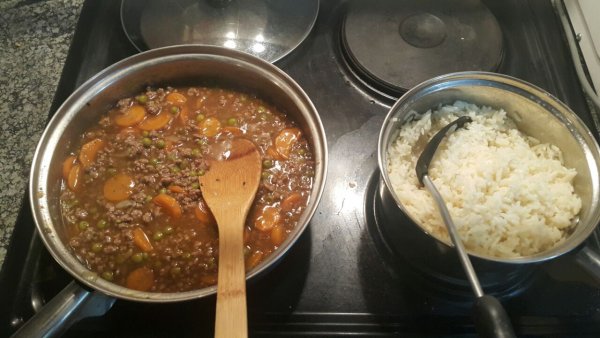
This is an awesome recipe I made this evening. It serves around 4 people, depending on hunger. What you will need: 500g mince 1 diced onion 2 carrots sliced thinly 1 small, drained can of peas 1 cup beef extract 1 cup of water Oil Salt and pepper to taste What you need to do: Braai the onions until brownish in the oil. Add your mince and cook until it is cooked. Add your cup of water and your vegetables. Let this simmer for about 20 minutes (until carrots are soft). Add the beef extract and let it simmer for another 10 minutes. Spice as you feel necessary. This dish is best served with rice. Having tried to be as cost-effective as possible I'm proud to say I could make this meal for under R70, it tasted great and checked off the vegetable category.
-
I have this thing about cooking rice in a bit of oil, makes my mouth water just thinking about it. So this recipe is right up there for me. Things you will need: 1 Cup parboiled rice A bit of oil 2 Raw eggs 1 Cup cooked chicken, cut into pieces ½ Cup spring onions Garlic (in whichever form you prefer) Chilli (optional but I like the kick) And then salt and pepper as you wish Things you will need to do: Steam the rice until ready to eat. Heat the oil in a saucepan. Whisk the egg until mixed well. Braai the rice in the oil along with the spring onions, garlic and chilli. Add the whisked egg, mix thoroughly. Add the chicken, mix well and you are all done and ready to eat.
-
When we are down and out the last week of the month, we all need a little inspiration. Post your favorite economical recipes to "help a brother out".
-
I appreciate that most greatly. Albeit most of my information is derived from our news sites. The only problem is they don't give all the information in their articles. I try to keep my posts short enough to read whilst making sure it is as complete as possible. The public deserves the truth and not just what the media decides to tell us. I do owe a big thank you to News 24 for their live tweeting when I can't be there.
-
No information that I can find on the case or when it is set to resume. We have three final experts left for the defence after which a verdict is hopefully served without a hold up.
-
Henri van Breda's application to testify has been dismissed by Desai. Desai said that there are no valid grounds for Henri to testify last and nothing prohibits him from amplifying or modifying his testimony when on the stand. Hence, Henri will not testify.
-
Day 41 of the trial and the media is in shambles. Will Henri take the stand or no? Advocate Botha said there's good cause for Henri to take the stand after the defence's witnesses. Albeit he is not certain Henri will actually take the stand. Three experts and two lay witnesses are still expected to testify for the defence it seems. Botha called the state's evidence circumstantial. There is no direct evidence against his client. Advocate Botha asked of Desai to let the expert witnesses go first and he will decide later whether Henri will take the stand. Botha said that at this stage of the trial he would not call Henri to testify. State prosecutor Galloway said that similar to remaining silent, not testifying also has its consequences. She said that a plea explanation is not evidence before the court. Botha said that his client is presumed innocent. His client has a right not to testify and to remain silent. The experts testify on evidence, not the plea explanation. Judge Desai will give his decision on Henri van Breda's defence application on the 27th of September. The court is adjourned.
-
I thought you would be quite despondent, as am I. What a sad day. It seems the trial is coming to a close though.
-
Today in court Captain Joubert was still being cross examined. Advocate Botha was asking about the blood flow on Henri's chest and of his forearm wounds. Botha showed a photo of blood on Henri's chest that deviates slightly to the left. Joubert said the reason for this could be from running after his attacker, his fall, fainting. Joubert described the blood from his forearm wounds as both a flowing and a smear. Botha suggested this could be from falling and brushing against something. There are numerous flow patterns on the face of Rudi van Breda, not all going the same direction. Joubert said he can't confirm which was created first. Joubert says deviations can be caused by saturation in his hair and the contours of his face. He said Rudi could have changed position after the first blow for the blood to flow in a different direction, he was lying on his back for a while to create the amount of blood. And quite possibly created some wipe patterns in his blood himself. There are three transfer patterns: the plug, the wall and the bathroom entrance. Botha then said that Rudi was dead when his head pushed against the wall in the three places. Joubert agreed. Botha said but this is impossible for Henri would have been standing in the blood and there was no blood beneath his socks. Joubert argued that Rudi could have been dragged by his feet and this could explain the movement of his arms. There are many possibilities. Botha wanted to know where the drag marks were. Joubert said for two thirds of the stain there is none but there are signs of it in the last part of the stain. Joubert said he didn't find any bloody marks on Rudi only smears from a bloody object making contact with the skin. Botha asked where the anger comes from? Joubert said it's an opinion, and that he is not a behavioral analyst. They moved on to the beginning of Henri's plea explanation, that he was on the toilet, not bothering to flush. There is a photo of the contents of the toilet. Henri heard more than one person in the house. Botha then refers to pictures of the bedding after the crime, the bedding seems to be mistakenly have been switched according to notes. Joubert then referred to evidence photos which correspond with his labeling. Galloway then reexamines Joubert. She asks if Henri made a call at 4:24 what the blood pools would have looked like? Joubert said that they would be liquid. Galloway also asked for signs of someone fleeing? Joubert said there were no unidentified shoe prints, no blood drips from a weapon and there is no sign Marli was attacked with a different axe. Joubert said Marli's blood could have been missed when taking the swabs. Joubert also said he asked during the investigation for an indication where Henri fell on the stairs but his reps wouldn't give more information. Also no information when he asked where Henri stood when he threw the axe. The state then said Marli expressed she does not want to be made available to the defence, confirms that she still suffers from memory loss. She will not be testifying I'm the trial. The case is adjourned until Thursday.
-
Day 39 and we got Captain Joubert back on the stand for further cross examination by the defence. Advocate Botha asked Joubert what the probability is that Henri cleaned himself up. Joubert said that this is a possibility. Botha and Joubert then continued to argue about Henri's throwing the axe without rotation, not causing the blood spatter Joubert thought he would find. Joubert kept his stance that he believes the axe was not thrown. Botha said it is not clear where Henri was when he threw the axe so it would be inaccurate to make assumptions about whether it was hit or thrown into the wall. Advocate Botha then referred to Joubert's finding that Rudi's body was moved. From day 1 Henri stood by it that Rudi was attacked on the bed. The suggestion here is that Henri van Breda manipulated the scene. Botha asked Joubert how it would be logical for Henri to move his body? Joubert said that he does not know. Botha then referred to the bloody fingerprints of Rudi on the bed base and said they either got there while he was dead or incapacitated or he did them himself. Joubert conceded that this is possible. If Rudi was not dead he could have moved and caused the bloody marks himself. Joubert said it is possible that Henri harbored a lot of anger towards Rudi and that's why only his position is manipulated. He showed his anger by pushing or dragging Rudi around. The previous expert, Perumal, said that Rudi could still have lived up to 2 hours and 40 minutes. Joubert said that the amount of blood indicates that Rudi died on the bed. Botha then asked if he could still have lived for so long could he have moved himself? To which Joubert replied that the blood stains don't concur with that. The court is adjourned until Monday when Joubert's cross examination will continue.
-
Day 38 of the trial. Joubert continued his testimony for the third day. Botha continued his cross examination if the state's witness. Joubert said that when they arrived on the scene, the blood on the axe was still liquid enough to run down the handle. Botha then said that there was a foreign allele found near Marli in a sample. Joubert said he could not comment on this as he was not a DNA analyst but a blood spatter specialist. Botha questioned the fact that Rudi's blood went out the window and landed on the neighbor's wall. He asked whether there should then not be blood on the frames of the window or the lampshade. To which Joubert replied that they can't collect every single spot on the scene, he does not remember. Advocate Botha maintains his stance that the blood had dripped in the path of flight. According to Henri it was not strange for the family members to use each other's bathrooms. Advocate Botha asked if this could explain the blood in the shower. Joubert said it could. (but honestly who goes to bleed in someone else's shower?) No DNA of Marli van Breda was found on Henri's shorts or socks or the axe. Captain Joubert said he can't exactly explain this. Desai asked him to do his best to which Joubert said the axe could possibly have been cleaned, as well as the fact that Marli's wounds are distributed, creating new wounds would result in minimum blood transfer. Joubert concedes it is nearly impossible that Marli's blood would not be on the axe. Advocate Botha said that according to Henri there were two attackers, this could explain the absence of blood and why there is no DNA of her found on Henri. Joubert said "Absence of evidence does not mean evidence of absence." The neurosurgeon who treated Marli said in an affidavit that the then 16 year old suffered five deep lacerations on her head, one on her wrist, and one on her neck. Captain Joubert said that the blood from Marli's attack would go away from the attacker. Position and other variables would influence this. No blood of Henri was found on any of the victims, nor on either duvets. Botha hammered on that there were unidentified stains. Desai clarified that unidentified does not mean an unknown person. A definitive answer on which of the family's it is could not be found. The court resumes tomorrow.
-
Day 37 not a whole lot has happened. Joubert continued his testimony. He said that Martin was probably attending to his injured son, Rudi, when he was attacked. Blood spatter suggests Teresa was in the doorway of Henri and Rudi's room when she was attacked, facing her attacker. Henri's version of being in the doorway of the bathroom when Rudi was attacked is being disputed by Joubert, saying that blood spatter places Henri next to the bed. The blood spatter shows him in close proximity and not in a slightly ajar doorway. There is also no blood spatter on the door or the walls. Blood stain evidence on the knife is also not consistent with Henri's plea explanation. The mixed blood in the bathroom is thought to be of a cleanup session. Containing the blood of Teresa, Rudi and Martin. Also of which there is no mention in Henri's plea. Joubert also says the flow patterns of the blood on Henri's upper body does not support his fainting and falling down the stairs version. Joubert said "It is my conclusion that the evidence does not support the actions/events described in Henri's statement" he also said he can't rule out that the scene was staged. According to Henri he was in the bedroom when Teresa was attacked, however, blood spatter is on his shorts and socks and it is impossible for blood spatter to travel from the passage around the wall of the bedroom to where he stood. Joubert believes Henri was in view of the attack on his mother. Joubert thought that with the throwing of the axe he would find blood spatters further up the wall and more distributed but there wasn't. Joubert said he has no explanation for the moving of Rudi's body, or the knife under the bed. Desai asked why there was no trace of Marli's blood. Joubert said it's possible because of the distribution of her injuries all over her head and not to just one spot. Joubert said it's presumptive to think the blood on the shorts could have happened when the EMS were there. He also said from Henri apparently being unconscious on the stairs, some blood did transfer. The court is adjourned until tomorrow.