



PirateJack
-
Posts
41 -
Joined
-
Last visited
Content Type
Profiles
Forums
Events
Articles
Everything posted by PirateJack
-
I saw this offering. Shiver me timbers what a mess.
-
Aye for ye Doubloons!
-
As a pirate I own some real gold, Keep it ssushhh. As for me buckos, you can either buy the mines that make the treaaye or you can buy a ETN that tracks it example http://etfcib.absa.co.za/products/exchange%20traded%20funds/commodities/newgold/Pages/default.aspx the NewGold Exchange Traded Fund Alternatively you can start collecting Krugerrands, which you can purchase through companies like the South Africa Gold Coin Exchange (www.sagoldcoin.com). You can buy smaller Krugerrands such as a 1/10 ounce coin, which would cost about R2400 now depending on the gold price at the time. ( http://www.scoinshop.com/en/shop/1-10oz-krugerrand/ ) That same coin was R900 in 2010 when I bought it.
-
If it is Black Rocks then I'd be interested in one that tracks the world excluding the US. With DbxUS which I own I can use one that's not US. In hindsight I should have bought DbxWD, but then again 5 years ago when I bought US it is paying off ever-since.
-
There's a relationship between net asset value (NAV), yield and total return, but it's complicated. Did you know that a fund's NAV can fall and you can still make money? Or that a fund can yield less than 1%—in fact, it can yield nothing at all—and yet its returns can still be at the top of the charts? There's two key components of total return in other words you can earn money from your investment in two ways: income (often called yield) and capital appreciation. Income and Capital Appreciation Income: A fund's income payout, or yield, tends to interest those investors who need regular income, because they don't necessarily have to tap into their principal for their day-to-day living expenses. Savings accounts pay income, but so do most bonds and some stocks. If you own a fund that buys income-paying stocks or bonds, the manager passes on any income to shareholders (after taking expenses off the top, of course). Capital appreciation: The second key way you can gain from a fund is through capital appreciation—that is, if one or more of your fund's holdings is selling for a higher price than it was when the manager purchased it. If the manager sells the new, pricier stock or bond, the fund clocks what is called a capital gain. And even if the manager simply hangs on to the stock or bond that has gained in value, the fund will enjoy capital appreciation; in other words, its NAV will increase. That's because the NAV is a reflection of the value of all of the securities in a fund at a given point in time. Distributions As counter-intuitive as it may seem, looking at a fund's NAV in isolation isn't always the best way to check up on its performance. That's because the NAV is vulnerable to changes that don't necessarily affect the true value of the fund. For example, a fund's NAV will change whenever a fund makes a payment to its shareholders, otherwise known as a distribution. So if a fund with an NAV of say, R50 makes a R10 distribution, its NAV slips to R40. Despite the shrunken NAV, shareholders are none the poorer. They still have R50: R40 in the fund and another R10 in cash. Unless they need the R10 in income to spend, most investors will reinvest their distributions back into the fund; in other words, they instruct the fund company to use that cash to buy new shares of the fund. Most total-return numbers reported in newspapers or on the Web, assume that you reinvest your distributions.
-
Energy forecasting is easy. It's getting it right that's difficult What is the future of Oil? What Oil ETF's/ETN's are available on the JSE?
-
Ay! Maity
-
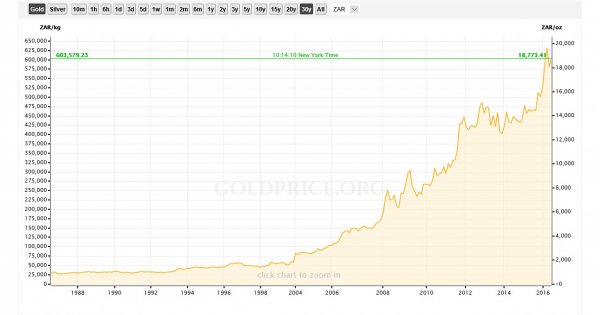
Gimme that old time religion: I thought it be a good idea to have a thread dedicated to the gold price and general gold trading/investing.
-
I have been reading and thinking a lot lately about the stigma of adult children living at home with their parents in South Africa and I guess the world actually. Personally, my parents and I had a rocky relations when I lived with them, but I moved out during college and our relationship has drastically improved. However, I can see that if you have a good relationship with your family, it could be a good thing to stay at home. This would only be beneficial if the adult child was working, contributed to rent and living expenses such as utilities and groceries, helped around the house, and generally contributed to the family and the home. So, both adult children and parents can benefit financially and by other means with this type of arrangement. I know that in many cultures it is the norm. So why is there such a push to get children out of the home in our society?
-
Minister says South Africans can survive on R753 a month
PirateJack replied to PirateJack's topic in General Chat
Not into politics, but dammit we need a change. -
Calculations by Wits researchers puts the estimated cost of essential food and non-food items needed to survive at R1,319 for a single person – and R5,276 for a household of four in SA. Source: http://businesstech.co.za/news/wealth/126321/minister-says-south-africans-can-survive-on-r753-a-month/
-
I like it. I have never seen this before so this really caught my attention when @Purply replied to my introduction thread I was surfing YouTube.com and all of a sudden a little pop up in the corner appeared! Very sleek.
-
Thanks so much
-
Wow, thanks for the welcome!
-
Hi, I am Pirate Jack. I know a little about finance, and stumbled across this website via a linkedin post. Well blow me away, how is this forum not advertised all over the place, I assume you guys started out recently? This community has great potential. I hope it grows exponentially almost like compounded interest
-
What do you guys think about JSE:MAPPSG ? I want to build my TFSA and that looks like a good ETF to hold for the long run
